What is the Gruha Jyothi Scheme in Telangana?
Managing household budgets can be stressful, especially with rising living costs. To help ease this pressure, the Telangana government rolled out a game-changing welfare program known as the Gruha Jyothi Scheme on March 1, 2024. This flagship initiative, launched under the state’s popular “Six Guarantees” program, ensures that domestic households across the state have access to basic electricity without financial strain.
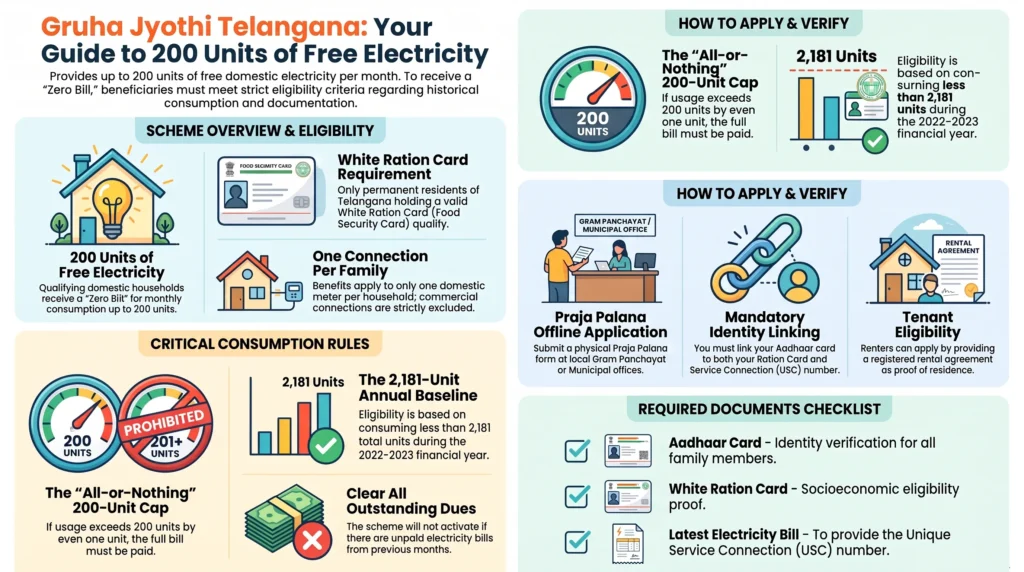
Under this scheme, eligible families receive free domestic electricity for up to 200 units per month. If your monthly domestic power consumption stays at or below this 200-unit ceiling, your net electricity bill is issued as a “ZERO Bill”. The state government directly reimburses the power distribution companies (DISCOMs) for the costs incurred, meaning the financial burden never falls on your shoulders.
Key Benefits of the Telangana Free Power Initiative
For families living in small towns, villages, and congested urban areas like Hyderabad, electricity bills can eat up a significant chunk of monthly income. The primary benefits of the scheme are:
- Direct Economic Support: It provides massive financial relief to economically weaker households. By bringing down domestic electricity costs to zero, families can reallocate their hard-earned money to other vital areas like healthcare, education, and savings.
- Inclusive Eligibility: Unlike restrictive older programs, the Gruha Jyothi Scheme in Telangana covers both self-owned residential properties and rented households, ensuring that tenants are not locked out of state welfare.
- Digital Transparency: The integration of the centralized Praja Palana database with DISCOM billing systems prevents leakage and ensures that subsidies are automatically adjusted right on your monthly bill.
Are You Eligible? Telangana Gruha Jyothi Eligibility Criteria Explained
Unlike universal subsidy programs that apply to everyone regardless of income, the Gruha Jyothi Scheme in Telangana uses a strictly targeted welfare model. To protect the state’s financial health, the government restricts the scheme’s benefits to low-income group households and genuine social welfare beneficiaries.
Socioeconomic and Technical Eligibility Checklist
To qualify for the zero-billing benefit, you must tick every single box in this technical and socioeconomic checklist:
- State Domicile: The applicant must be a permanent resident of Telangana.
- Socioeconomic Classification: The household must hold an active Food Security Card, commonly known as a White Ration Card. This card is typically issued to families who require state food security and medical assistance.
- Domestic Single-Meter Connection: The subsidy is strictly applicable to active domestic residential accounts with a single physical meter per household.
- Strict Identity Linking: You must link your Aadhaar card with your White Ration Card, and both must be successfully linked to your domestic electricity Unique Service Connection (USC) number.
- Strict Non-Commercial Use: Any commercial or industrial electricity connections are strictly excluded. If a beneficiary is found using domestic zero-billing power for non-residential or commercial purposes, they face penalties and prosecution under the Electricity Act, 2003, and the Indian Penal Code.
Rules for Tenants and Rented Properties in Telangana
If you live in a rented home in Hyderabad or any other part of Telangana, you are fully eligible to claim the 200 units of free power. The government does not require the electricity meter to be registered in your name.
To apply as a tenant, you must submit valid proof of residency, such as a registered rental agreement, lease deed, or a local Voter ID card showing the rental address, alongside your Aadhaar card. The DISCOMs will continue to generate the monthly bill in the name of the recorded house owner, but the zero-billing subsidy will be applied based on your verified tenancy and White Ration Card.
Settling Arrears: A Prerequisite for Approval
Before submitting your application for the scheme, you must check your account for outstanding dues. If your domestic connection has past unpaid electricity bills (arrears), the government will delay the activation of your subsidy. DISCOM servers are programmed to block zero-bill generation for any accounts showing a history of unpaid dues, meaning you must clear all old bills before you can start enjoying free power.
How is Your Zero Bill Calculated? The 2,181-Unit Historical Formula
A common misconception among consumers is that anyone with a White Ration Card can simply walk in, apply, and get free power. To prevent artificial consumption inflation—where households might intentionally waste electricity to hit the 200-unit ceiling—the Telangana government uses a strict historical usage baseline from the 2022–2023 financial year to filter applicants.
Breaking Down the Mathematical Baseline Formula
The mathematical formula used to establish your baseline eligibility is calculated as follows:
- Annual Baseline Consumption: The government sets a baseline of 2,160 units per year.
- Adding the Operational Buffer: To account for hot summers, seasonal shifts, and family celebrations, a 10% operational buffer is added to the annual limit: {Entitlement with Buffer} = 2160×1.10 = 2376 units
- Monthly Average Threshold: This buffered annual total is divided by 12 to find your monthly average allowance: {Monthly Operational Threshold} = 2376/12 = 198 { units/month}
Based on this historical formula, only households whose total electricity consumption was less than 2,181 units during the 2022–2023 base year are eligible to enroll in the scheme. If your home consumed more than 2,181 units during that year, you are technically ineligible for the subsidy, even if your current monthly usage drops below 200 units.
The Buffer Concept: Operational Baseline Buffer Explained
The 10% operational buffer was designed as a consumer-friendly safety net. It ensures that if a low-consumption family has a temporary spike in energy use during peak summer, they are not permanently disqualified from the scheme.
However, this baseline is purely an intake filter. Once you are successfully enrolled in the program, your baseline history is locked, and you must adhere to the actual monthly consumption cap of 200 units during each active billing cycle to receive your zero bill.
The All-or-Nothing Rule: Crucial Billing Pitfalls to Avoid
Understanding the exact billing model used by the Telangana government is critical to avoiding shock bills at the end of the month. The Gruha Jyothi Scheme in Telangana operates on a strict binary (“all-or-nothing”) tariff structure, rather than a progressive slab-rate system.
What Happens If You Cross 200 Units?
In a progressive slab-rate system (like the one used in Karnataka), if you consume 205 units, you only pay for the extra 5 units. Telangana’s model does not work this way.
If your monthly electricity usage remains at or below 200 units, you get a zero bill. But if your consumption crosses the 200-unit limit by even a single unit (e.g., 201 units), the subsidy is completely cancelled for that billing cycle. You will be disqualified for that month and must pay the entire standard tariff for all 201 units consumed, not just for the 1 unit above the limit. Mallu Bhatti Vikramarka, the Deputy Chief Minister and Energy Minister, explicitly clarified that “this scheme is only for those who consume less than 200 units”.
The Danger of Delayed Meter Readings
Because of this strict binary cutoff, the timing of your monthly meter reading is incredibly important. In the real world, utility meter readers do not always arrive on the exact same day each month due to holidays, weekends, or staff shortages.
If a meter reader delays visiting your home by just two or three days, those extra days of tracked power consumption will be added to your current bill. For a household that averages 6 units per day, a three-day delay can easily push their monthly total from a safe 190 units up to 208 units. This delay instantly disqualifies them from the subsidy, leaving them with a standard bill. Under this rule, consumers are effectively left at the mercy of the meter reader’s schedule.
Step-by-Step Guide: How to Apply for Gruha Jyothi in Telangana
Ready to get your electricity bill down to zero? The application process in Telangana is simple, but it is currently 100% offline. You cannot complete this registration on a website, but you can download the official forms online.
Downloading and Filling the Praja Palana Form
Applications for the Gruha Jyothi Scheme are managed through the state’s unified Praja Palana (Public Administration) welfare campaign. Here is how to fill out the form:
- Get the Form: Download the official Praja Palana application form PDF from the centralized Praja Palana portal, or collect a physical copy from your local ward office.
- Basic Details: Fill in your personal details, including your name, family composition, and contact information.
- Check the Box: Navigate to the “Gruha Jyothi Scheme” section and check the enrollment box.
- Enter Your USC Number: Write down your Unique Service Connection (USC) number exactly as it appears on your electricity bill.
- Indicate Your Consumption Range: Check the box corresponding to your typical monthly power consumption:
- 0 to 100 units
- 100 to 200 units
- Above 200 units
Required Documents Checklist
When submitting your Praja Palana form, you must attach photocopies of the following documents:
- Aadhaar Card: Copy of the applicant’s Aadhaar card (Aadhaar verification is mandatory under G.O. Ms. No. 7).
- White Ration Card: Copy of your active Food Security Card (White Ration Card).
- Latest Electricity Bill: A photocopy of your last month’s bill containing your consumer ID and USC number.
- Tenant Proof (If Applicable): Copy of a registered rental agreement, lease deed, or local address proof.
Submitting the Form Offline
Once your form is filled and documents are attached, hand over the physical bundle to your local Gram Panchayat, Gram Sabha, Municipal Corporation Office, or designated Praja Palana Seva Kendram. There are no application or registration fees.
Once received, the operator will verify your physical papers and upload your details to the centralized Praja Palana database. The system will run an automatic database check against the state’s Civil Supplies registry to verify your White Ration Card. If your details match, your zero-billing status will be approved, and the subsidy will be automatically applied to your next billing cycle.
How to Check Your Gruha Jyothi Application Status Online
Once you have submitted your paperwork, you can easily track your approval status online:
- Visit the official Praja Palana Portal (prajapalana.telangana.gov.in).
- Click on the “Track Application Status” link.
- Enter your Application Reference Number (ARN) or your Aadhaar-linked mobile number.
- The portal will display your current stage (e.g., Registered, Under Verification, Approved, or Pending).
Frequently Asked Questions (FAQs)
What happens if I consume 201 units of electricity in Telangana?
If your consumption exceeds the 200-unit limit by even a single unit, you completely lose the subsidy for that month. You will be issued a standard bill and must pay the full tariff for all 201 units consumed.
Can tenants apply for Gruha Jyothi Telangana if the meter is in the landlord’s name?
Yes. Renters are fully eligible to apply. You do not need to change the connection name. Simply submit your White Ration Card, Aadhaar card, and a copy of your registered rental agreement or lease deed.
Is online registration available for the Telangana Gruha Jyothi Scheme?
No, the registration process is strictly offline. You must submit a physical Praja Palana form at your local Gram Panchayat, ward office, or Municipal Corporation. However, you can download the forms online and track your application status on the official Praja Palana portal.
How do I transfer an electricity connection after shifting to a new home?
To maintain your benefits when shifting homes, you must clear all old bills, update your address details, and link your Aadhaar card to the new connection’s Unique Service Connection (USC) number. If the connection remains linked to a previous tenant or deceased family member, you must first request de-linking at your local ESCOM office or a MeeSeva center before registering fresh.