Going solar in India is no longer just a green choice—it is a financial necessity. With electricity tariffs rising across states and the central government’s massive push, over 1.7 crore households have already registered on the National Portal. This solar revolution is powered by the PM Surya Ghar: Muft Bijli Yojana (PMSG:MBY), a landmark ₹75,021 crore scheme designed to solarize 1 crore Indian homes by the end of FY 2026-27.
If you are a homeowner wanting to reduce your monthly bill to zero or a solar installer looking to deliver smooth, hassle-free projects, this guide is for you. Below, we break down the exact subsidy rates, technical requirements, and step-by-step registration workflows to make your transition completely bulletproof.
What is the PM Surya Ghar Muft Bijli Yojana?
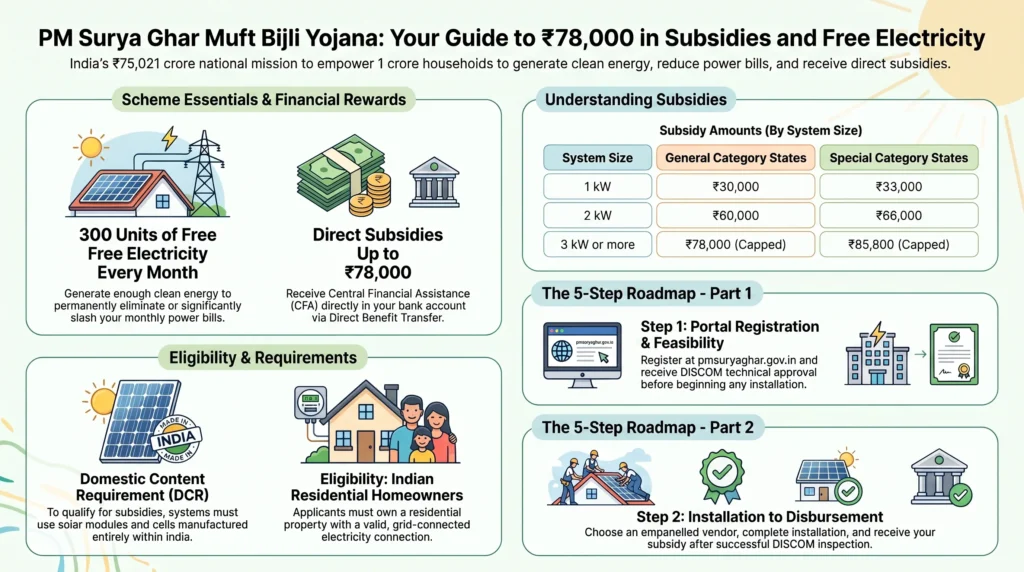
Launched in February 2024, the PM Surya Ghar: Muft Bijli Yojana is a monumental central government initiative with a total financial outlay of ₹75,021 crore. The primary goal of this scheme is to help 1 crore households across India install grid-connected rooftop solar (RTS) systems.
By installing rooftop solar, eligible households can generate clean electricity, reduce their carbon footprint, and access up to 300 free units of electricity every month. The scheme operates under a standardized national framework but integrates closely with state-level distribution companies (DISCOMs) to simplify net metering, inspections, and subsidy payouts.
PM Surya Ghar Subsidy Slabs and Sizing Calculations
The central subsidy—formally known as Central Financial Assistance (CFA)—is a direct benefit transfer (DBT) that is credited directly into the customer’s verified bank account within 30 days of system commissioning. The subsidy is calculated as a fixed amount based on the installed capacity up to a 3 kW limit, beyond which no additional central subsidy is provided.
Central Subsidy (CFA) Slabs:
- 1 kW System: ₹30,000 fixed subsidy (on a benchmark cost of ₹50,000/kW).
- 2 kW System: ₹60,000 fixed subsidy (on a cumulative benchmark cost of ₹1,00,000).
- 3 kW System (and above): ₹78,000 fixed subsidy. For any system capacity beyond 3 kW (e.g., 5 kW or 10 kW), the subsidy is capped at ₹78,000.
- Group Housing Societies (GHS) & Residential Welfare Associations (RWAs): ₹3,000 per kW for common facilities (such as elevators and common area lighting), up to a maximum capacity of 500 kW.
Special Category State Benefits
For consumers residing in Special Category States and Union Territories—including Uttarakhand, Himachal Pradesh, Jammu & Kashmir, Ladakh, Sikkim, the North-Eastern states, and the Andaman & Nicobar and Lakshadweep islands—the benchmark costs are set higher to account for logistical challenges, offering enhanced regional support.
State-Specific Top-Up Subsidies
Many states have converged their own budgets with the central scheme to offer additional top-up subsidies, reducing the consumer’s upfront share even further:
- Gujarat (GEDA): Adds a state subsidy to bring the total benefit for a 3 kW system up to ₹88,000 to ₹93,000.
- Maharashtra (MEDA): Provides state top-ups pushing the total incentive to ₹83,000 to ₹93,000.
- Madhya Pradesh: Offers aggressive state top-ups reaching ₹88,000 to ₹98,000 in total benefits.
- Delhi: The Delhi Solar Policy 2024 features up to ₹50 crore in State Top-up funding for 2.3 lakh residential rooftops. It also introduces a generous Generation-Based Incentive (GBI) of ₹3.00 per unit of solar energy generated for systems up to 3 kW, and ₹2.00 per unit for larger systems.
Step-by-Step National Portal Registration Walkthrough (pmsuryaghar.gov.in)
The entire application-to-disbursement process is digitized through the official National Portal. To avoid common processing bottlenecks, applicants must carefully follow these nine core steps:
- Portal Sign-Up: Access the portal at pmsuryaghar.gov.in. Select your State, District, and local Electricity Distribution Company (DISCOM). Enter your electricity Consumer Account Number exactly as it appears on your monthly bill.
- OTP Verification: Enter your active mobile number and email address to receive and submit the One-Time Passwords (OTPs) for registration.
- Feasibility Approval: Once logged in, apply formally for Rooftop Solar Feasibility. The DISCOM will review your connected load and local grid capacity, automatically granting technical clearance (typically auto-approved up to 10 kW).
- Selecting an Empanelled Vendor: After feasibility clearance, select a certified, empanelled solar installer from your local DISCOM’s approved list on the portal. Do not sign a contract with an un-empanelled vendor, or your subsidy will be rejected.
- Finalizing Terms and the Agreement: Mutually decide on system design, component brands, and pricing. Sign a standardized Consumer-Vendor Agreement using the official MNRE model draft. This agreement commits the vendor to design, supply, install, and commission the plant.
- Installation & Civil Works: The vendor will execute complete civil, structure, and electrical works following strict BIS standards.
- Documentation & Inspection: After physical installation, upload the system details (module serial numbers, inverter model, DCR certificates, layout, and Single Line Diagram) to the portal. The DISCOM officer will conduct a physical inspection to verify compliance with technical specifications.
- Net Meter Integration: The DISCOM will install a bidirectional net meter to track export and import energy. They will issue a formal Commissioning Certificate.
- Claiming Your Subsidy: Submit your bank details, upload a scan of a cancelled cheque or bank e-statement, and complete the “Subsidy Redeem” request on the portal. Your ₹78,000 subsidy will be credited via DBT directly to your account within 30 days.
Technical Compliance, Quality Standards, and E-E-A-T Signals
The Ministry of New and Renewable Energy (MNRE) has established rigid quality standards to protect consumers and grid safety. Non-compliant equipment is the leading cause of technical rejections.
The Domestic Content Requirement (DCR) Mandate
To claim the PM Surya Ghar subsidy, the rooftop system must use domestically manufactured solar PV modules made from domestically manufactured solar cells.
- The “Give It Up” Campaign Exception: If a homeowner chooses to forgo the subsidy under the “Give It Up” option on the portal, they are completely exempt from the DCR mandate and can use imported modules/cells.
The ALMM Registry and Equipment Standards
All modules must belong to models registered under the MNRE’s Approved List of Models and Manufacturers (ALMM).
- Solar Modules: Must carry unique RFID tags and serial numbers for complete traceability under ISO 9001 and ISO 14001.
- Solar Inverters: Must meet safety standards like IS 16221 Part II and feature active anti-islanding functions to shut off solar generation during grid power failures, protecting utility linemen.
- DC & AC Cabling: Must utilize flexible, multi-strand, annealed copper conductors on the DC side with UV-protected, armored/XLPE extruded insulation rated for a 25-year operational life.
- Structural Guidelines: Leg-to-rafter connections must be bolted securely (minimum 12 mm diameter bolts), purlins must have a minimum 2 mm thickness in Lip sections, and fasteners must be SS-304 or hot-dip galvanized Grade 8.8 to withstand heavy winds.
The Mandatory 5-Year Maintenance and Warranty
Every empanelled vendor is legally bound to provide 5 years of comprehensive operation and maintenance (O&M) on the installed system. They are responsible for keeping the plant’s Performance Ratio (PR) within active warranty limits.
Overcoming Portal Rejections and Net Metering Bottlenecks
While demand is skyrocketing, thousands of applicants experience long delays or rejections due to preventable documentation errors. Installers who utilize pre-submission check-gates save 15 to 30 days of re-processing time per job:
- The Name Mismatch Rejection: This is the single most common failure point. The consumer’s name must be spelled identically across Aadhaar, the electricity bill, and the bank account. A single character spelling error triggers an automated portal rejection.
- The Fix: Correct the name on the electricity bill or bank passbook before starting portal submission.
- System Sizing Exceeding Sanctioned Load: You cannot install a solar capacity that exceeds your home’s approved sanctioned load. In Gujarat and Maharashtra, DISCOMs reject applications where the solar capacity exceeds 90% of the active connected load.
- The Fix: Apply for a sanctioned load upgrade through the DISCOM portal first (often auto-approved up to 10 kW).
- Substandard Single Line Diagrams (SLD): Applications are frequently stalled at Stage 2 (Technical Sanction) due to handwritten, incomplete, or unsigned SLDs.
- The Fix: Ensure the SLD is exported from professional design tools and is formally stamped and signed by an electrical contractor with an active state L1 license. The diagram must explicitly illustrate the solar array, inverter, export/import net meter, MLDB, earthing rods, lightning arresters, and all wire gauges.
Summary of Key Guidelines and Best Practices
To succeed in this massive rooftop market, both consumers and installers should implement these operational habits:
- For Homeowners: Ensure Aadhaar, bank passbooks, and utility bills are identical in name spelling. Always choose a portal-empanelled vendor and sign the standard bilateral contract.
- For Installers: Set a firm 48-hour submission rule to upload complete net metering and subsidy files as soon as the physically commissioned meter is active. Use structured pre-submission checklists to reduce rejection rates to under 5%.
PM Surya Ghar Frequently Asked Questions (FAQ)
Can I install a solar system capacity higher than my sanctioned load?
No. Your solar system capacity is strictly capped by your registered sanctioned load with the DISCOM. If your active load is 2 kW and you submit an application for a 3 kW solar array, it will be rejected outright. You must request a connected load increase on your DISCOM’s portal before applying.
Does a net metering rejection affect my subsidy eligibility?
Not directly, but it creates extensive delays. A technical rejection does not disqualify you, but it forces a complete re-submission. If your portal registration expires during this delay, you may have to restart the queue.
How do I maintain my solar panels under the 5-year vendor contract?
While the empanelled vendor is responsible for a 5-year comprehensive warranty, routine upkeep like basic dust cleaning (manual or robotic) must be done regularly to maximize PR efficiency. The vendor must educate you on basic O&M safety during handover.
What is the “Give It Up” option on the portal?
It is a feature that allows environmentally conscious, high-income consumers to opt-out of the central subsidy. By selecting this option, they free themselves from the Domestic Content Requirement (DCR), allowing them to purchase and install imported solar modules or cells.