From Aasara to Cheyutha: The Story Behind Telangana’s Safety Net
The structural architecture of social safety nets within the South Indian state of Telangana has undergone a massive evolution, heavily influenced by shifting political leadership and changing public welfare philosophies.
The foundation of the modern state-level social security pension system was laid on October 1, 2014, with the launch of the landmark “Aasara” pension scheme by the then-ruling Bharat Rashtra Samithi (BRS) administration. Prior to this intervention, old-age and vulnerability stipends in the region were critically limited, providing just ₹200 for standard categories and ₹500 for disabled individuals. The newly introduced Aasara scheme dramatically raised these monthly disbursements to ₹1,000 and ₹1,500 respectively. At its inception, this program required a state expenditure of ₹4,700 crore and successfully threw a lifeline to approximately 37.65 lakh individuals. Over the years, standard stipends were further enhanced in June 2019 to ₹2,016 for regular categories and ₹3,016 for differently-abled beneficiaries to cushion the impact of inflation.
Following the historic change in state leadership, the Congress-led administration under Chief Minister A. Revanth Reddy initiated a comprehensive, systemic restructuring of these welfare systems. Central to this transition was the rebranding of the social security pension network as the “Cheyutha” scheme. This initiative was officially integrated into the highly publicized “Abhayahastham” six guarantees framework, designed to deliver robust, multi-dimensional social protection through a phased, time-bound implementation model.
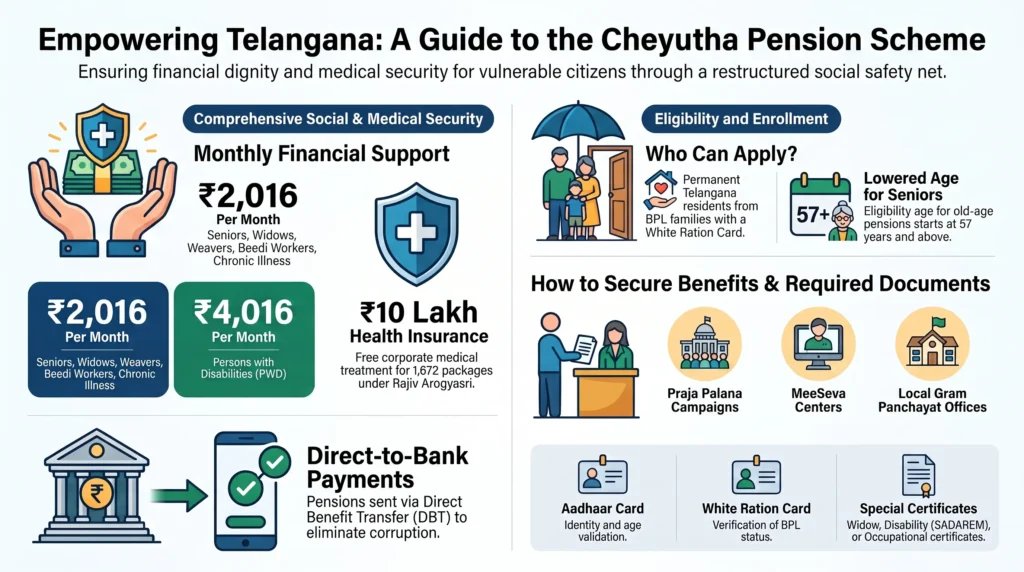
What makes the modern Cheyutha scheme stand out from traditional pension programs is its operation as a dual-benefit welfare mechanism. In addition to receiving monthly direct cash transfers, beneficiaries are integrated into the state’s healthcare safety net. The policy provides free medical and corporate healthcare coverage of up to ₹10 lakh per household under the prestigious Rajiv Arogyasri initiative. This comprehensive health insurance component targets approximately 90.10 lakh Below Poverty Line (BPL) families, allowing them to access corporate medical treatment across 1,672 distinct medical packages and 21 specialty services in all empanelled public and private corporate hospitals.
Who Qualifies for Cheyutha Pension? Complete Eligibility & Exclusion Criteria
The targeting mechanism of the Cheyutha scheme is structured around specific categories of vulnerability, utilizing strict demographic, clinical, and occupational parameters to identify eligible households.
While the baseline monthly transfer under the current budget stands at ₹2,000 to ₹2,016 for standard categories and ₹4,016 for differently-abled individuals, the state government has outlined an enhanced pension scale of ₹4,000 and ₹6,000 on several district-level portals, such as the Wanaparthy administrative database. This phased rollout has sparked major online interest, with thousands searching daily for the official implementation timelines.
Beneficiary Architecture and Mandatory Documentation
| Target Beneficiary Category | Age / Medical Eligibility Parameters | Baseline Monthly Stipend | Enhanced Scale | Mandatory Documentation for Verification |
|---|---|---|---|---|
| Senior Citizens (OAP) | Age 57 years | ₹2,000 / ₹2,016 | ₹4,000 | Aadhaar card, BPL white ration card, certified age proof |
| Widows | Age 18 years | ₹2,000 / ₹2,016 | ₹4,000 | Death certificate of spouse, local administrative verification |
| Persons with Disabilities | No age limit; Age 40% disability (Age 51% for hearing impaired) | ₹4,016 | ₹6,000 | Certified SADAREM disability assessment certificate |
| Single Women | Age 18 years (deserted >1 year); Unmarried: Age 30 years (rural), Age 35 years (urban) | ₹2,000 / ₹2,016 | ₹4,000 | Signed marital status affidavit, local inquiry report |
| Handloom Weavers | Age 50 years; must be actively engaged in traditional weaving | ₹2,000 / ₹2,016 | ₹4,000 | Copy of registration in Handloom Weavers Cooperative Society |
| Toddy Tappers | Age 50 years; covered under the “Tree For Tappers” scheme | ₹2,000 / ₹2,016 | ₹4,000 | Copy of registration in Toddy Tappers Cooperative Society |
| Beedi Workers | Age 18–50 years; EPF-enrolled but not receiving an EPF pension | ₹2,000 / ₹2,016 | ₹4,000 | EPF enrollment card, local employment verification |
| Beedi Thekedars | Age 18 years; licensed contract intermediaries | ₹2,000 / ₹2,016 | ₹4,000 | Valid manufacture license, local occupational audit |
| HIV/AIDS Patients | No age limit; must be undergoing active clinical treatment | ₹2,016 | ₹4,000 | Diagnostic logs, registration at state-run ART centers |
| Dialysis Patients | No age limit; must be undergoing active medical dialysis | ₹2,016 | ₹4,000 | Nephrology reports, certified hospital dialysis logs |
| Filaria Patients | No age limit; diagnosed with Grade II or Grade III filariasis | ₹2,016 | ₹4,000 | Clinical identification certificate issued by health officer |
The “No-Go” Rules: Who is Disqualified?
To make sure these valuable public resources are directed exclusively to the truly marginalized, the Telangana government enforces strict socio-economic exclusion criteria. A household is immediately disqualified from receiving any Cheyutha pension if they meet any of the following conditions:
- Land Limits: Ownership of more than 3.0 acres of wet/irrigated agricultural land or more than 7.5 acres of dry agricultural land.
- Government Employment: Having family members employed in government, public sector undertakings (PSUs), or organized private sector jobs. This includes contract, outsourced, or temporary staff.
- Professional Children: Having children who work as self-employed professionals, including doctors, engineers, contractors, or business consultants.
- Commercial Enterprise: Ownership of commercial business enterprises like oil mills, rice mills, petrol retail outlets, or large shops.
- Vehicle Ownership: Ownership of four-wheelers (cars) or heavy commercial vehicles.
- Double Pensions: Active receipt of other government pensions (such as freedom fighter or institutional pensions).
- Income Ceilings: Annual household income exceeding ₹1.5 lakh in rural areas or ₹2.0 lakh in urban municipal limits.
How to Apply for Cheyutha Pension: A Step-by-Step Guide
Applying for the Cheyutha pension is designed to be highly accessible and close to the community. While some commercial portals falsely advertise a 100% online application, the official process requires local administrative physical routing and verification. Here is the exact step-by-step workflow:
Step 1: Secure the Official Application Form
You have two main paths to obtain the application form:
- The Digital Route: You can search online for “Praja Palana application form PDF download” and print the document directly from official district sites (like kamareddy.telangana.gov.in).
- The Offline Route: Visit your local Gram Panchayat (village office), Ward Office, or the nearest MeeSeva service center to collect a physical copy.
Step 2: Fill Out and Cross-Reference Your Details
Carefully fill out your personal information. Make sure your name, date of birth, and Aadhaar number match exactly across all documents. Minor spelling mismatches are one of the leading causes of application delays or rejections during field inspections!
Step 3: Attach Mandatory Documents
Ensure you attach clear photocopies of:
- Aadhaar Card (linked to an active mobile number).
- BPL White Ration Card (or Food Security Card).
- Certified proof of age (birth certificate or school records; if unavailable, the marriage certificate of your children or age proof of grandchildren may be accepted).
- Category-Specific Proof: Such as a SADAREM disability certificate (showing age 40% disability), a husband’s death certificate for widows, cooperative society registration copies for weavers/toddy tappers, or EPF enrollment cards for beedi workers.
Step 4: Submit to Local Administrative Officers
Hand over your completed application pack directly to:
- The Gram Panchayat Secretary or Village Revenue Officer (VRO) in rural villages.
- The designated Bill Collector or ward representative at municipal offices in urban areas.
- Make sure to collect your Acknowledgement Receipt containing a unique reference number for future status tracking.
How to Do a Cheyutha Pension Status Check Online
Once your application is submitted, it undergoes physical field verification and database mapping. You can easily check your real-time status online.
Method A: Verification Using Your Aadhaar Number
This is the fastest and most convenient method:
- Go to the official state portal at www.aasara.telangana.gov.in.
- Navigate to the “Quick Search” or “Search Beneficiary” section.
- Click on the “Search by UID” option.
- Enter your 12-digit Aadhaar number and hit submit.
- The system will instantly pull up your active status, beneficiary details, and recent payment history.
Method B: Checking by Pension ID or SADAREM ID
If you already have a sanctioned pension card:
- On the official homepage, click on “Search Pensioner Details”.
- Input your unique Pension ID or your SADAREM ID (for disabled beneficiaries).
- The portal will display your clearance status, approval dates, and any pending actions.
Method C: Checking via Geographical Browsing
If you have misplaced your ID cards:
- Go to the search screen on the official site.
- Use the dropdown menus to select your District, Mandal, and Gram Panchayat.
- Enter the name of the Head of the Family.
- Click search to browse the approved beneficiary lists for your local neighborhood.
FAQs on Telangana Cheyutha Pension
What is the current monthly pension amount under the Cheyutha Scheme?
The baseline monthly stipend is ₹2,016 for standard categories (senior citizens, widows, single women, weavers, toddy tappers, beedi workers, HIV/AIDS, dialysis, and filaria patients) and ₹4,016 for persons with disabilities. However, several district administrative portals show that the state is working toward an enhanced scale of ₹4,000 for regular categories and ₹6,000 for disabled individuals.
Why is my pension being transferred to a bank account instead of the post office?
In May 2026, Chief Minister Revanth Reddy ordered a full transition of all disbursements from post offices to direct bank account transfers. This shift was designed to simplify distribution, eliminate manual transaction delays, and automate the payment cycle. If you do not have a bank account, you are advised to open a zero-balance account (such as a Post Office Savings Account) to prevent any payment delays.
What is the liveness verification audit, and why was it conducted?
The liveness audit was launched after SERP discovered that 5,650 individuals (including retired government pensioners) were drawing double pensions, and 3,824 accounts belonged to deceased individuals. The audit uses secure facial-recognition devices to verify that the registered beneficiary is active prior to releasing funds.
My status check online shows “Not Found.” What does this mean?
This status typically means your application is still undergoing field inspection or your data entry is pending. It can also indicate a mismatch in your Aadhaar or liveness registration. You should visit your nearest MeeSeva center or contact your Gram Panchayat Secretary to verify your documents.
Can multiple members of the same household receive the Cheyutha Pension?
No. Under state regulations, only one pension is allowed per household. The priority is given to female-headed households without physically capable earning members.
Final Thoughts: Securing Your Financial Future
Telangana’s Cheyutha Pension Scheme is a crucial social safety net, helping millions of vulnerable families meet their daily needs and live with dignity. However, while public welfare programs offer essential support, combining these benefits with personal savings and robust life insurance planning is the best way to secure your family’s long-term financial independence. Take the first step toward securing your future today!