Agricultural investment support is the lifeblood of rural development and economic stability in southern India. In Telangana, this critical financial mechanism has undergone a major transformation with the introduction of the Rythu Bharosa Scheme, the flagship direct benefit transfer (DBT) initiative launched by the Congress-led state government.
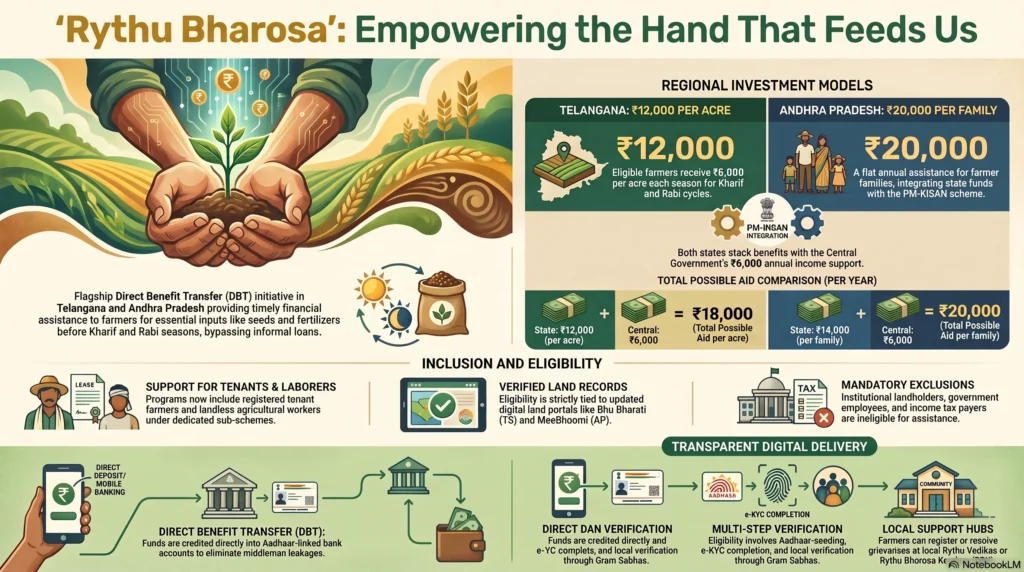
This scheme officially replaces the legacy Rythu Bandhu program, which was originally launched in 2018 under the Bharat Rashtra Samithi (BRS) administration. While the former Rythu Bandhu program provided ₹10,000 per acre annually (distributed as ₹5,000 per season), the restructured Rythu Bharosa program delivers an enhanced assistance of ₹12,000 per acre each year. This is split into two equal seasonal installments of ₹6,000 per acre for both the Kharif (Vanakalam) and Rabi (Yasangi) crop cycles.
Although the ruling party had initially proposed ₹15,000 per acre annually (₹7,500 per season) during its election campaign, the state government finalized the operational support at ₹12,000 per acre per year. This direct input assistance helps farmers purchase essential seeds, fertilizers, and pesticides, reducing their dependency on high-interest informal credit networks.
For the 2026-27 financial year, the Telangana state budget has allocated a massive ₹18,000 crore specifically for Rythu Bharosa. This makes it the single largest expenditure item among the state’s “Six Guarantees,” which collectively require ₹50,713 crore, out of a total state budget of ₹3,24,234 crore.
For farmers, active cultivators, and researchers navigating this evolving policy landscape, this comprehensive guide offers step-by-step instructions on checking payment status online, reviews the 2026 seasonal release schedule, details the strict new eligibility guidelines, and examines the ongoing administrative reforms surrounding tenant farmers.
How to Perform a Rythu Bharosa Status Check by Aadhaar (Online & Offline)
With the state government disbursing funds in multiple staggered phases based on land size, keeping track of your payment status is essential. To ensure absolute transparency and eliminate middlemen, the state government has digitized its direct benefit transfer architecture. Farmers can verify their payment disbursements quickly and easily online or offline.
Method 1: Checking Status Online via the Official Portal
The official web application designed and maintained by the National Informatics Centre (NIC) Agriculture Informatics Division is the primary tool for verifying payments:
- Open your web browser and navigate to the official portal:
https://rythubharosa.telangana.gov.in. - On the home page, click on the “Check Amount” or “Know Your Status” option.
- A status check form will load. Select the option to verify your account using your Aadhaar Number. You can also search using your Pattadar Passbook Number or Application ID.
- Enter your 12-digit Aadhaar card number carefully in the provided field.
- Complete any displayed captcha or security verification.
- Click “Submit”. Your screen will display your personalized transactional details, including the beneficiary name, geographical location (district, mandal, village), installment number, bank transaction ID, credit date, and payment status (e.g., ‘Credited’, ‘Processed’, or ‘Failed’).
Method 2: Verifying Status via the Praja Palana Framework
For newly registered farmers or those whose digitized land records have undergone recent mutation:
- Praja Palana Portal: Farmers can track their physical application status online by visiting
https://prajapalana.telangana.gov.inand inputting their application number or registered mobile number. - Village Secretariats & Gram Sabhas: Printed copies of the verified beneficiary lists are sent directly to localized Gram Panchayats and Rythu Vedika offices for public inspection and physical verification during the state’s Praja Palana campaigns.
Common Technical Glitches and Payment Failures
If your status displays as “Failed” or “Rejected”, or if you have not received your funds despite being eligible, it is usually due to one of the following technical bottlenecks:
- NPCI Aadhaar Mapping Issues: Direct Benefit Transfers (DBT) are executed strictly via Aadhaar-enabled payment systems. If your primary bank account is not mapped with the National Payments Corporation of India (NPCI), the transaction will fail. To resolve this, visit your bank branch and submit an Aadhaar seeding form.
- Incomplete e-KYC: Landholders must complete their mandatory biometric or OTP-based e-KYC. This can be verified online through the central PM-Kisan portal or in person at Mee-Seva or Common Service Centres (CSCs).
- Pattadar Name Spelling Discrepancy: Any spelling mismatch between your bank passbook, Aadhaar card, and Bhu Bharati digitized land registry will cause the automated system to halt your payment. You must submit correction requests to your local Mandal Revenue Officer (MRO) to rectify the records.
Rythu Bharosa 2026 Payment Schedule: Kharif & Rabi Sowing Seasons
Managing cash flows for a state-wide direct income transfer scheme requires navigating significant fiscal demands alongside broader budget priorities. To handle these fiscal pressures, the current Congress administration has transitioned away from the flat, simultaneous releases of the past to a staggered model that prioritizes small and marginal landholders first.
To help you understand the payment timelines, here is a detailed breakdown of seasonal disbursements and recent state budget outlays:
Telangana Crop Support Seasonal Payout Trends (2024–2026)
| Crop Season | Actual Outlay / Payment Release Details | Operational Status & Timelines |
|---|---|---|
| Vanakalam (Kharif) 2024 | Skipped Entirely due to severe state budget deficits and resource mobilization challenges. | No direct investment support was released during this season. |
| Yasangi (Rabi) 2024–25 | Restricted strictly to marginal and smallholders owning 3 acres or less. | Staggered rollout totaling approximately ₹4,000 crore. |
| Vanakalam (Kharif) 2025 | Released ₹8,744 crore directly to 69.40 lakh landowning pattadars. | Phase 1 credited ₹2,349.83 crore on June 16, 2025, targeting 41.25 lakh farmers with up to 2 acres. The remaining phases were completed over 9 days. |
| Yasangi (Rabi) 2025–26 | Total seasonal allocation of ₹9,000 crore. | Staggered over a 45-day window starting late March 2026. The initial tranche of ₹3,600 crore targeted over 70 lakh farmers holding up to 1 acre. |
| Vanakalam (Kharif) 2026 | Out of a total Agriculture and Cooperation Department outlay of ₹21,851 crore, a dedicated ₹18,000 crore was allocated for Rythu Bharosa in the state budget. | Seasonal rollout commenced on June 30, 2026. By July 4, 2026, the government completed its fifth phase, transferring ₹7,135.77 crore directly to 67.44 lakh farmers with up to six acres of land. |
Critical Agricultural Advisory for Kharif 2026
With dry monsoonal intervals and fluctuating water levels reported across several districts, the Telangana state cabinet, led by Agriculture Minister Tummala Nageswara Rao, has issued a critical moisture advisory for the Kharif 2026 season.
Farmers are strongly urged not to rush into premature sowing immediately after the first light rains. Agricultural scientists advise that at least two spells of around 7 mm of rainfall each are absolutely necessary to create sufficient soil moisture depth. Sowing seeds in dry or inadequately moistened soil runs a high risk of poor seed germination, seedling mortality, and subsequent financial crop loss if dry spells persist.
Detailed Eligibility Criteria under Rythu Bharosa Guidelines PDF
To prevent the historical misuse of public funds—which previously paid out support on concrete plots, commercial real estate, and non-arable lands—the state government has established highly targeted eligibility conditions:
- Centralized Bhu Bharati Registration: To qualify, all cultivable land holdings must be registered and verified on the centralized Bhu Bharati revenue portal (which replaced the legacy Dharani portal). The digital passbook serves as the single source of truth for land titles and acreage.
- Cultivable Land Restrictions: Payouts are limited strictly to active, cultivable agricultural land. Land segments converted for non-agricultural uses, such as real estate layouts, industrial parks, active mining/quarry zones, and long-term uncultivated fallow plots, are systematically excluded from the beneficiary list.
- Recognition of Forest Rights (ROFR) Alignment: Tribal and forest-dwelling cultivators who hold valid ROFR certificates are treated on par with registered landowners and receive the same seasonal payouts.
- Applicant Age Limits: The primary registered landholder or cultivator must be between 18 and 59 years of age to qualify for direct payouts.
- High-Income and Institutional Exclusions: Following federal guidelines, institutional landholders (trusts, temples), current or former constitutional post holders, MPs, MLAs, gazetted government officers, and professional taxpayers (doctors, lawyers, chartered accountants) are excluded.
Secondary Benefits: Paddy Crop Bonus and Rythu Bima Alignment
Beyond direct seasonal acreage cash transfers, registered agriculturalists under the Rythu Bharosa operational net are automatically aligned with two high-value state-funded safety nets:
1. The ₹500 Paddy Crop Bonus
To encourage the cultivation of high-value domestic food varieties and stabilize rural incomes, the state government provides an additional Paddy Crop Bonus of ₹500 per quintal paid directly on top of the Minimum Support Price (MSP).
By structural mandate, this bonus is strictly restricted to seven approved fine rice varieties that enjoy strong market demand:
- BPT-5204 (Samba Mahsuri)
- RNR-15048 (Telangana Sona)
- HMT Sona
- Jai Sriram
- KNM-1638
- WGL-44
- KNM-7715
These seven approved fine varieties collectively account for nearly 83% of all fine rice production in Telangana.
2. The Rythu Bima Life Insurance Program
Registered landholders on the Rythu Bharosa database are automatically linked to the state-funded Rythu Bima program.
- The Benefit: Provides a flat ₹5 lakh life insurance cover.
- Administration: The policy is fully funded by the state government and administered through the Life Insurance Corporation (LIC) of India.
- Nominee Protection: In the unfortunate event of the registered farmer’s death (irrespective of the cause), the entire ₹5 lakh insurance payout is transferred directly to the bank account of the designated family nominee within a specified time window. No premium is collected from the farmer.
Frequently Asked Questions (FAQs)
Is Rythu Bandhu still active in Telangana?
No, the Rythu Bandhu scheme is no longer active. It has been restructured and replaced by the Rythu Bharosa scheme under the current state government. All future seasonal agricultural investment support is managed under the Rythu Bharosa guidelines.
How much is paid under Rythu Bharosa per acre?
The scheme provides direct financial assistance of ₹12,000 per acre per year. This amount is disbursed in two equal seasonal installments of ₹6,000 per acre for the Kharif (Vanakalam) and Rabi (Yasangi) cropping seasons.
How do I perform a Rythu Bharosa status check online?
You can verify your seasonal payment status by visiting the official portal at rythubharosa.telangana.gov.in. Click on “Check Amount”, select search by “Aadhaar Number” or “Pattadar Passbook Number”, enter your details, and submit to view your transaction status.
Are tenant farmers eligible for Rythu Bharosa?
Yes, under the official policy framework, registered tenant cultivators who hold a valid Crop Cultivator Rights Card (CCRC) are eligible for support. However, because of practical hurdles in obtaining landowners’ signatures for CCRC cards, many tenant farmers remain excluded on the ground.
What are the documents required for new registration?
To apply for Rythu Bharosa, you must submit the following documents at your local Village Secretariat or Gram Panchayat:
- Updated Pattadar Passbook or Bhu Bharati Land Registration Certificate.
- Unique Aadhaar Card (linked to your mobile number and bank account).
- Aadhaar-seeded Bank Passbook with active IFSC details.
- Active Ration Card (for residence proof).
- Signed lease documents or a valid Crop Cultivator Rights Card (CCRC) (for tenant cultivators).
Can I receive both Rythu Bharosa and PM-Kisan payments?
Yes, eligible landowning farmers can receive benefits from both schemes. PM-Kisan is a central sector scheme providing ₹6,000 per year directly to eligible families. Rythu Bharosa is an independent state scheme providing ₹12,000 per acre annually. Receiving state support does not affect your eligibility for central PM-Kisan transfers
🌿 For real-time agricultural updates, official notification releases, and localized crop advisories, regularly monitor the official Telangana Agriculture Department website.