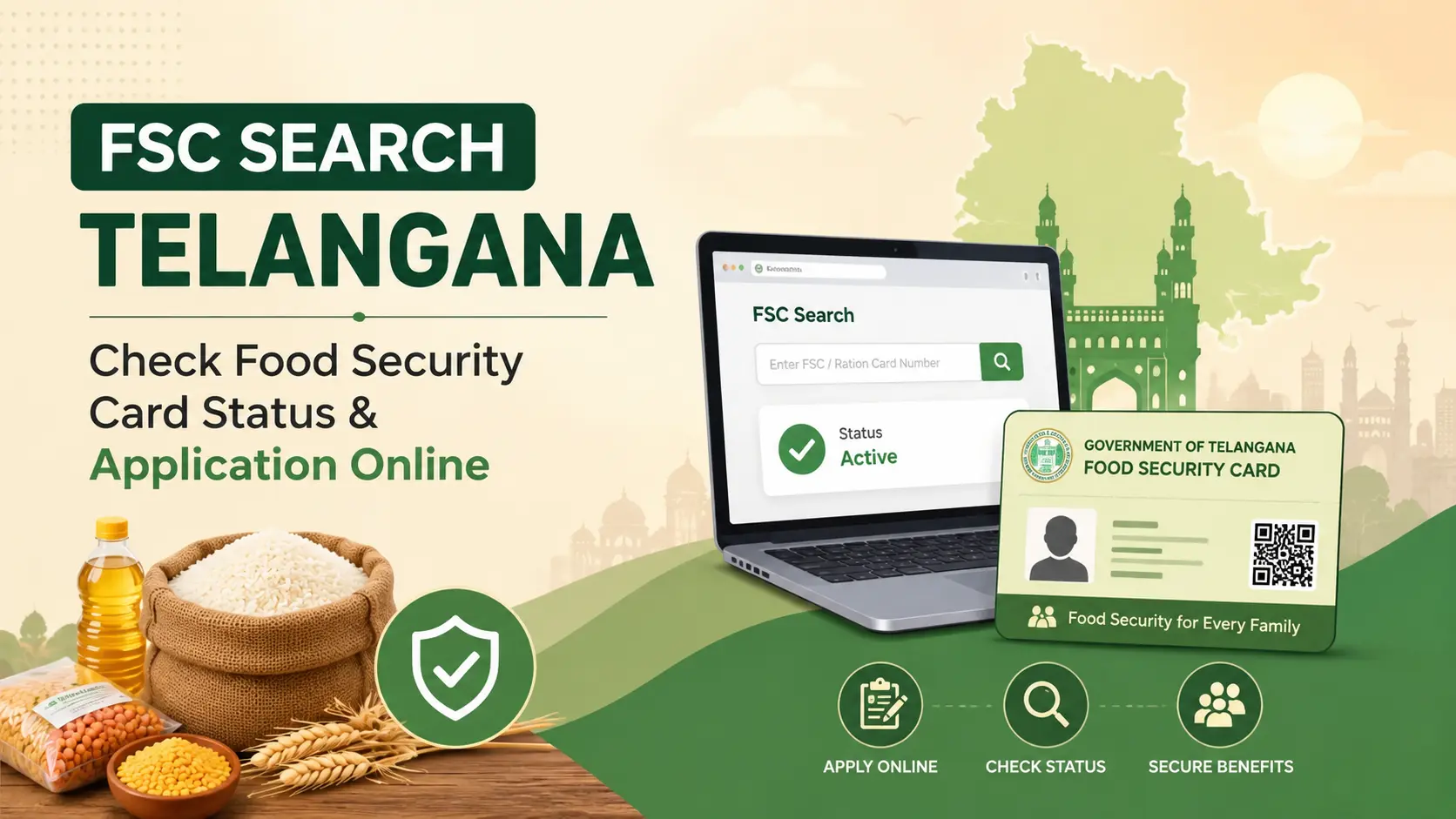
The digitalization of public social security infrastructure represents a massive administrative transformation, transitioning legacy, paper-bound registry systems into real-time, biometrically authenticated databases. In India, the public distribution of subsidized essential commodities has undergone a significant paradigm shift since the passage of the National Food Security Act (NFSA) in 2013.
At the center of this modern digital architecture is the Food Security Card (FSC), also commonly referred to as a Ration Card. In the state of Telangana, these cards act as a nutritional safety net and a foundational identity document for families. To manage this database, issue updates, and run real-time transaction tracking, the Consumer Affairs, Food and Civil Supplies Department of Telangana utilizes the integrated Electronic Public Distribution System (ePDS).
If you are a resident of Telangana, performing an “FSC Search” is the most direct way to check whether your card is active, track your application status, or download your digital card copy. In this comprehensive guide, we will walk you through the step-by-step process of checking your FSC details online, troubleshooting portal errors, exploring linked state welfare schemes, and resolving search ambiguities across other technical domains.
What is the ePDS Telangana Food Security Card (FSC)?
The Electronic Public Distribution System (ePDS) is an online software application developed to manage ration cards, allocate resources, and seed Aadhaar demographic data. By automating the processes involved in distributing essential commodities to families, the Civil Supplies Department brings transparency, efficiency, and real-time accountability to the public distribution network.
This digital network cleans up and authenticates beneficiary records, automates work issuance, and speeds up approvals. It allows poor and low-income households to access government-supported food supplies such as rice, wheat, pulses, sugar, and kerosene at subsidized rates through village and ward-level retail outlets.
The Critical Difference Between a Ration Card and a Food Security Card (FSC)
While many citizens still use the terms interchangeably, there is an important administrative distinction. Following the passage of the National Food Security Ordinance in 2013, the traditional paper ration cards were reorganized under a unified electronic database. The term Ration Card historically referred to a physical logbook used to record monthly collections of commodities.
Today, the Food Security Card (FSC) is an electronic, Aadhaar-linked identity file stored within the state database. An active FSC guarantees that a household is legally entitled to monthly subsidized grain quotas under the National Food Security Act.
The state of Telangana issues several types of cards based on household vulnerability:
- FSC (Priority Household / PHH Card): Commonly given to Below Poverty Line (BPL) families to secure basic grain allotments.
- AFSC (Antyodaya Anna Yojana / AAY Card): Reserved for the most financially vulnerable households, guaranteeing a fixed monthly quota of food grains regardless of family size.
- APL (Above Poverty Line / Non-Priority Card): Used primarily as a verified proof of identity or residence, rather than for accessing subsidized food commodities.
Income and Landholding Eligibility Criteria for Telangana FSC
The Telangana government regularly holds registration drives to cover eligible beneficiaries under the public distribution system. The eligibility verification process is managed online and offline by regional authorities. The primary factors determining eligibility include:
- Residency: The applicant must be a permanent resident of Telangana state.
- Income Categories: The household must belong to the BPL or AAY categories to receive subsidized commodities.
- Aadhaar Seeding: It is mandatory for all family members listed on the card to have their unique 12-digit Aadhaar numbers linked and biometrically verified.
- Existing Card Check: The applicant and family members must not possess any active ration cards in other states under the One Nation One Ration Card (ONORC) framework.
Step-by-Step Guide: How to Perform an FSC Search on epds.telangana.gov.in
If you need to verify your card details, check if a newly applied card has been processed, or view your seeded family members, you can execute a live query using the official ePDS portal. Below are the two primary search methods:
Method 1: FSC Search by Aadhaar Number or UID (Recommended)
Using your 12-digit Aadhaar card is the fastest and most foolproof way to retrieve your details because biometric profiles are mapped directly to individual ePDS beneficiary records.
- Go to the official EPDS Telangana website at
epds.telangana.gov.in. - Locate the utility navigation menu on the homepage and click on “Search Details”.
- Select the option labeled “FSC Search” or “FSC Search by Aadhaar Number” from the directory list.
- A secure database query screen will open. Choose your registered District from the drop-down menu.
- Enter your unique 12-digit Aadhaar Number (UID) in the designated input field.
- Input the security Captcha code exactly as displayed on the screen.
- Click the “Submit” or “Search” button.
- The system will pull your live Food Security Card data from the state database, displaying your active FSC Card Number, shop number allocation, and seeded family members.
Method 2: FSC Application Status Search (For New Applications)
If you recently applied for a new Food Security Card through local MeeSeva centres or village revenue conferences (Revenue Sadassulu), you can track your application status using your transaction number.
- Access the official ePDS portal at
epds.telangana.gov.in. - Navigate to the “FSC Application Search Telangana” tab on the dashboard.
- Select your local district from the directory menu.
- Enter the unique MeeSeva Application Number printed on your acknowledgement receipt.
- Click the “Search” or “Submit” button.
- The portal will return your current application lifecycle status (e.g., Pending, Approved, Rejected, or Under Verification). Once your card status turns to “Approved,” your new FSC number and allocated dealer details will be generated.
How to Download and Print Your Digital FSC (e-Ration Card)
Once your FSC search yields a valid, active status, you can secure a print-ready digital copy (e-Ration Card) for identity verification and administrative purposes.
- Downloading via ePDS: On your completed search results screen, click on the “Download e-Ration Card” or “Print Card” button to save a secure PDF copy of your verified card to your device.
- Downloading via the Mera Ration App: Beneficiaries, especially migrant workers, can download the official Mera Ration app from the Google Play Store. Simply log in using your Aadhaar number, select the “Aadhaar Seeding” utility, and download your card details in an easy-to-read layout.
- Accessing via DigiLocker: Food Security Cards are officially recognized digital documents. By logging into your personal DigiLocker profile, selecting the Consumer Affairs, Food and Civil Supplies Department of Telangana, and inputting your FSC number, you can import a digitally signed e-card into your secure vault.
District-Wise FSC Search & FP Shop Details Lookup
The actual distribution of subsidized food grains in Telangana is carried out through a vast network of decentralized retail outlets called Fair Price Shops (FPS) or ration shops. Every cardholder is assigned to a specific shop dealer based on their residential ward or village.
Finding Your Assigned Fair Price Shop (FPS) and Dealer Info
If you move to a new area or need to find out where to collect your monthly grain quota, you can perform an online search to find your assigned dealer:
- Navigate to the official Telangana ePDS transaction hub (AePDS) at
smartpds.telangana.gov.in. - Click on the reporting module titled “FPS Status” or “FPS Transactions”.
- Choose your local District and administrative Mandal.
- The system will output a list of active Fair Price Shops. Select your allocated FP Shop Number (e.g., the unique ID mapped to your card).
- The AePDS report will display the active dealer’s name, localized stock ledger reports, and the shop’s operational status.
ePDS Telangana Portal Monthly Distribution Analytics (July 2026 Data)
To give you an idea of the scale of Telangana’s public distribution system, the state portal tracks millions of monthly transactions in real time. The following database metrics illustrate the active footprint of ePDS Telangana for the month of July 2026:
| Portal Reporting Metric | Live Database Count (As of July 2026 Distribution Cycle) |
|---|---|
| Total Registered Food Security Cards | 1,06,06,041 active cards |
| Beneficiaries Availed Grains (Current Month) | 93,36,111 cardholders |
| ONORC Portability Transactions | 38,89,910 portability card transactions |
| Total Registered Fair Price Shops | 17,327 shops |
| Active Fair Price Shops This Cycle | 4,602 shops |
| Monthly Transaction Success Rate | 88.03% successful transaction rate |
| Total Recorded Monthly Transactions | 93,64,916 completed transactions |
Troubleshooting Common ePDS Portal Issues & Error Codes
Official government portals handle millions of concurrent hits, which can lead to common system bottlenecks and connection timeouts. Below are the most frequent portal issues and how to resolve them:
Resolving Captcha and Case-Sensitivity Verification Errors
If you repeatedly get error alerts stating that your verification code is incorrect:
- Disable Browser Translators: Auto-translation plugins can sometimes alter the background source string of dynamic Captcha images, causing verification mismatches.
- Check Keyboard State: Portal Captcha fields are highly case-sensitive. Ensure your Caps Lock key is set correctly before entering characters.
- Refresh Image: If a Captcha image is blurry or difficult to read, click the refresh icon next to the input box to generate a new alphanumeric string.
Handling Timeout Overloads and Page Not Loading (Error 4)
State servers often experience intense database lag during periods of high user traffic.
- System Traffic Peaks: Portal traffic consistently spikes during the first five days of each month when monthly grain distribution opens. Daily peak traffic hours occur between 10:00 AM and 4:00 PM on business days.
- Optimal Search Windows: To avoid connection timeouts, perform your searches during off-peak windows—ideally in the early morning (6:00 AM to 9:00 AM) or late evening (8:00 PM to 10:00 PM).
- Browser Optimization: If the page refuses to load, clear your browser’s cache and cookies, or switch from a mobile browser to a desktop browser.
Resolving Database Synchronization Delays
If your newly approved card number or recent data correction is not appearing during a search:
- Allow Sync Time: When corrections are approved at the village or mandal level, expect a synchronization delay of 24 to 72 hours before the changes update on state-level servers.
- Check Offline Status: If your card details are missing on the ePDS search but show on local ePoS devices, it indicates a temporary database sync delay.
Government Welfare Schemes Linked to Your Telangana FSC
An active Telangana Food Security Card is a foundational document that establishes your eligibility for various other state and national welfare programs.
Rajiv Aarogyasri Health Insurance Integration
Telangana’s premier cashless health insurance program, the Rajiv Aarogyasri Scheme, is directly integrated with the state ePDS database.
- Welfare Access: Families holding an active FSC are automatically eligible for cashless healthcare coverage up to Rs. 5.00 Lakhs per annum for listed therapies and surgical procedures at empanelled network hospitals.
- Biometric e-KYC Verification: When visiting an empanelled hospital, beneficiaries use state-certified biometric scanners (utilizing updated L1 devices) to authenticate their active FSC records against the Aarogyasri healthcare database.
National Welfare Portability (ONORC)
Under the One Nation One Ration Card (ONORC) initiative, an active Telangana FSC can be used to claim subsidized rations anywhere in the country. This is especially helpful for migrant workers, who can seamlessly claim their food security benefits at any local Fair Price Shop in other states using biometric e-KYC authentication.