Imagine stepping into your college campus on day one, eager to learn, but with a heavy weight on your chest. You are constantly worrying about tuition fees, hostel expenses, and whether your family can afford to keep you enrolled. For lakhs of students in Telangana, this is a daily reality. Fortunately, the Telangana government has pioneered a digital lifesaver to bridge this financial gap: the Telangana Electronic Payment and Application System of Scholarships, popularly known as TS ePASS.
Run by the Centre for Good Governance (CGG) on behalf of the Scheduled Castes (SC), Scheduled Tribes (ST), Backward Classes (BC), Economically Backward Classes (EBC), and Minority Welfare departments, the TS ePASS portal handles over 700,000 student applications every year. Whether you are a first-time applicant trying to navigate a “Fresh Registration” or an existing beneficiary submitting a “Renewal Application,” this comprehensive guide is designed for you.
We will break down the eligibility rules, detail the exact documents you need, walk you through the newly mandated biometric verification and Aadhaar-NPCI seeding processes, and give you troubleshooting tips to ensure your application gets approved and paid on time.
What is TS ePASS?
At its core, What is TS ePASS? It is a highly integrated, completely transparent digital welfare portal designed to distribute academic financial assistance directly to those who need it most.
Electronic Payment and Application System of Scholarships Overview
Before the introduction of the online system in 2007-08, applying for scholarships in undivided Andhra Pradesh was a slow, paper-heavy process prone to massive delays, administrative backlogs, and lost files. To bring accountability and efficiency to the system, the government launched the Electronic Payment and Application System of Scholarships (ePASS).
Instead of relying on self-reported declarations or physical certificates that could easily be misplaced, the modern TS ePASS backend features real-time API integrations with massive national and state databases. When you enter your details on the portal, the system triggers real-time verification checks with the Secondary School Certificate (SSC) database, the Board of Intermediate Education (BIE) registry, and various state Common Entrance Test (CET) portals.
This deep digital integration serves two vital purposes:
- Speeds Up Approvals: It instantly verifies your identity, academic enrollment, and socio-economic category.
- Prevents Double-Dipping: By cross-referencing your One-Time Registration (OTR) credentials with the National Scholarship Portal (NSP), TS ePASS ensures that no student receives overlapping benefits from both state and central government programs.
TS ePASS Scholarship Eligibility Criteria 2026-27
Before you click “Apply Now,” you need to verify if you qualify. The eligibility criteria are divided into financial thresholds, academic conditions, and age limits.
Category-wise Annual Income Thresholds
The TS ePASS program is strictly a means-cum-merit scholarship, meaning your household income determines your eligibility. The state government sets different annual income limits depending on your category and whether you reside in a rural or urban area.
SC & ST Student Income Limits
To ensure that historical inequities do not block access to higher education, Scheduled Caste (SC) and Scheduled Tribe (ST) students are given the highest income limits.
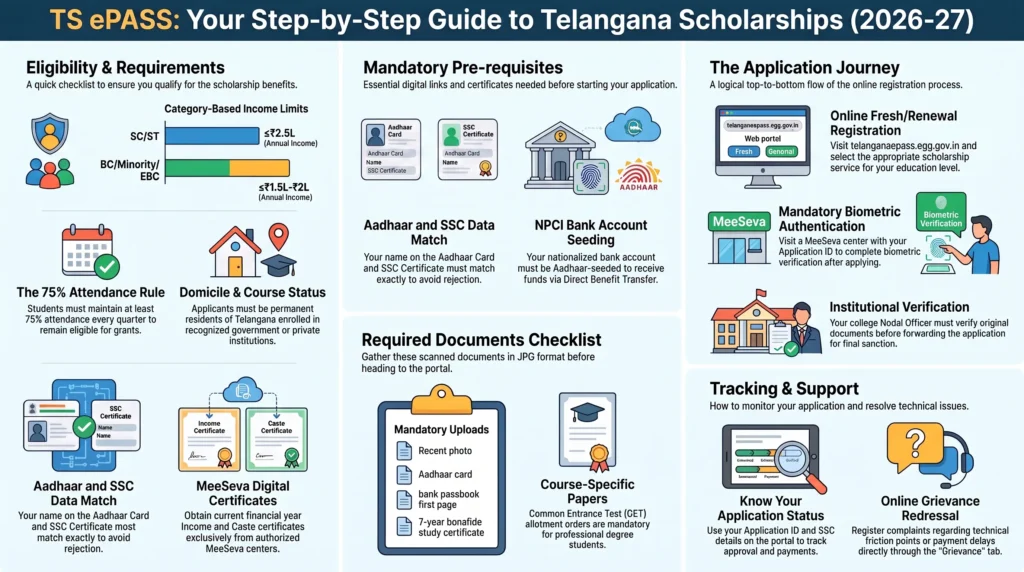
- For Post-Matric Scholarships, the annual family income from all sources must be less than or equal to ₹2,50,000 (though some domestic guides list a threshold of ₹2,00,000 depending on the specific welfare department).
- For Pre-Matric Scholarships (Classes 9 and 10), the household income limit is ₹2,00,000 per annum.
BC, EBC, Minority & Disabled Welfare Student Income Limits
For other categories, the income caps are structured as follows:
- BC & Minority Students:
- Urban Residents: Annual family income must not exceed ₹2,00,000.
- Rural Residents: Annual family income must not exceed ₹1,50,000.
- Economically Backward Classes (EBC):
- For standard college courses, the limit is ₹1,50,000 (rural) or ₹2,00,000 (urban) depending on the specific welfare department’s guidelines.
- Please note that EBC students pursuing intermediate courses are generally excluded from reimbursement unless they are admitted under the state’s specialized Corporate College Admission Scheme.
- Disabled Welfare (DW) Students:
- The annual family income limit is set at ₹1,00,000 or less (though some portals allow up to ₹2,50,000 under specific disability assistance programs).
Mandatory Academic and Domicile Conditions
Meeting the income requirements is only half the battle. To secure and keep your scholarship, you must satisfy several strict academic and residency conditions.
Domicile of Telangana Requirement
The TS ePASS scholarship is funded entirely by the taxpayers of Telangana. Therefore, you must be a permanent resident (domicile) of Telangana to apply. If you are a Telangana resident but are studying at a premier national institution outside the state (like an IIT or NIT), you can still apply through the dedicated “Other State Scheme” link on the portal. However, students residing in other states are not eligible to claim these state-specific funds.
Minimum 75% Quarterly Attendance Rule
The government treats this scholarship as an investment in your future. To maintain accountability, colleges are required to upload attendance data at the end of each academic quarter. You must maintain a minimum of 75% attendance in each quarter. If your attendance falls below this mark, your scholarship disbursement will be blocked automatically.
Maximum Student Age Limits
To prioritize support for students pursuing direct academic paths, TS ePASS enforces maximum age limits (calculated as of July 1st of the academic year). These limits depend on your course category and demographic group:
- Group I (Professional Degrees): SC, ST, and BC students must be 29 years or younger, while EBC, Minority, and Disabled students must be 25 years or younger.
- Group II (Technical PG & Diplomas): SC, ST, and BC students must be 34 years or younger, while EBC, Minority, and Disabled students must be 30 years or younger.
- Group III (General Degrees): SC, ST, and BC students must be 29 years or younger, while EBC, Minority, and Disabled students must be 25 years or younger.
- Group IV (Intermediate Education): SC, ST, and BC students must be 24 years or younger, while EBC, Minority, and Disabled students must be 20 years or younger.
Step-by-Step Guide to TS ePASS Fresh Registration (2026-27)
If you are entering college as a first-year student, you will need to apply under Fresh Registration. The portal typically opens for fresh applications between August and September, right after college admissions conclude. Follow these steps carefully to ensure a smooth application process.
1. Pre-requisites and Mandatory Documents Checklist
Before opening the portal, gather all your documents. Every document must be scanned clearly—blurry photos or incomplete scans will result in immediate rejection. Keep the following ready:
- SSC Hall Ticket Details: Your Class 10 hall ticket number, passing year, and board type (Regular, Supplementary, CBSE, ICSE, or Open Schooling).
- Aadhaar Card: Your Aadhaar card number. Crucially, the name on your Aadhaar card must match your SSC marksheet exactly, letter-for-letter. If there is a spelling mismatch, visit a MeeSeva center immediately to correct it before starting your application.
- Caste Certificate: A digitally signed Caste Certificate obtained from a MeeSeva center with a valid barcode.
- Income Certificate: A digitally signed Income Certificate issued by a competent Mandal Revenue Officer (MRO/Tahsildar). For the 2026-27 academic year, this certificate must be issued after April 1, 2026 (01-04-2026) to reflect your current financial status (or after April 1, 2025 if applying for previous backlogs).
- 7-Year Study/Bonafide Certificates: Consecutive study and bonafide certificates covering the last seven (7) years of study up to your qualifying exam. If there was a gap in your studies, you must provide a residency certificate from your local MRO to prove your local status during that gap period.
- CET Allotment Order: If you secured your seat through a Common Entrance Test (such as EAMCET, ECET, ICET, etc.), you must upload your official convener allotment order. Students admitted under management quotas or spot admissions are completely ineligible.
- Passport-size Photograph: A recent color photograph (max size: 30KB in JPG format).
2. Mandatory Biometric Authentication at MeeSeva
The government has introduced a mandatory biometric verification step to eliminate identity theft and paper-based fraud. Once you enter your basic details and generate your initial ePASS profile, the portal will issue a temporary Application ID. You must then visit your nearest MeeSeva center in person. Show them your Application ID and provide your fingerprint or iris scan. This biometric data is cross-referenced in real-time with the UIDAI Aadhaar registry to confirm your identity. Once verified, your application is officially unlocked for final submission.
3. Bank Account Requirements and Aadhaar Seeding
The TS ePASS portal uses Direct Benefit Transfer (DBT) to deposit maintenance allowances directly into your bank account. This requires a specialized banking setup.
- Nationalized Bank Account: You must hold an active savings account in a nationalized bank. For ease of access, India Post Payments Bank (IPPB) accounts are now fully accepted along with traditional nationalized banks.
- The Aadhaar Seeding Process: Merely linking your Aadhaar card to your bank account for KYC purposes is not the same as seeding. Seeding requires mapping your Aadhaar number to your account within the National Payments Corporation of India (NPCI) mapper. When any government department initiates a DBT transfer, the NPCI central database automatically routes the funds to the last seeded bank account.
- To complete this, you must submit a physical consent form (Aadhaar Seeding Form) to your bank branch and ask the branch officials to update the NPCI mapper. Alternatively, you can use the Bharat Aadhaar Seeding Enabler (BASE) digital portal to complete this process online.
How to Check TS ePASS Scholarship Status Online
Once your application is submitted, it goes through several rounds of physical and digital checks. Instead of visiting government offices, you can easily track your application’s progress online.
Step-by-Step Process on telanganaepass.cgg.gov.in
- Visit the official portal: https://telanganaepass.cgg.gov.in.
- Click on the “Application Status” or “Know Your Application Status” option.
- Enter the following details exactly as they appear on your registered application:
- TS ePASS Application Number.
- SSC Exam Hall Ticket Number.
- Academic Year (e.g., 2026-27).
- SSC Pass Type (Regular/Supplementary/CBSE/ICSE/etc.).
- Year of Passing SSC.
- Date of Birth (DD-MM-YYYY).
- Click “Get Status”. Your complete verification timeline, along with any disbursed amounts, will appear on the screen.
How to Find a Lost TS ePASS Application Number
If you lose your Application Number, don’t worry—you can retrieve it online. On the portal’s homepage, select the “Know Your Application No.” link. Enter your registered date of birth, SSC hall ticket number, year of passing, academic year, and SSC pass type. Click search, and the portal will retrieve your registered Application ID.
Decoding Application Status Messages
As your file moves through the approval chain, you will see different status messages. Here is what they mean and the actions you need to take:
- “Verification Pending at College”: Your application is sitting with your college’s nodal officer. You must submit your physical documents and bonafide certificate to your college principal’s office to initiate their verification.
- “Pending at Field Officer”: The college has approved your file. It is now with the local Welfare Department’s Field Officer, who will verify your MeeSeva caste and income certificates against the government servers.
- “Aadhaar Seeding Inactive” / “NPCI Mapping Failed”: The welfare department attempted a payment, but it bounced because your bank account is not mapped on the NPCI central database. You must visit your bank branch immediately to resolve the seeding issue.
- “Sent to Treasury”: Congratulations! Your application has been approved at all administrative levels. Your scholarship amount has been calculated and sent to the state treasury for fund release.
Understanding TS ePASS Scholarship Course Groups & Amount Details
The TS ePASS program is designed to cover a wide variety of courses, from vocational training to super-specialty medical degrees. To manage this, the system categorizes courses into four distinct groups.
Classification of Academic Course Groups (Group I to IV)
- Group I: Professional degrees, including MBBS, BDS, B.Tech, B.Pharmacy, B.Sc. Agriculture, BVSc (Veterinary Sciences), MBA, MCA, and Commercial Pilot training.
- Group II: Technical postgraduate degrees (such as M.Tech, M.Pharmacy, M.Sc.), doctoral research programs (Ph.D., Post-Doctoral), professional certifications like CA, ICWA, CS, and graduate/postgraduate diplomas of 1 year and above.
- Group III: General graduation degrees (like B.A., B.Sc., B.Com) not covered in Group I or II, along with courses offered by the National Institute of Fashion Technology (NIFT).
- Group IV: Intermediate education (Classes 11 and 12), ITI (Industrial Training Institutes), ITCs, and intermediate-level vocational programs.
Reimbursement of Tuition Fee (RTF) vs. Maintenance Fee (MTF) Structures
The financial support is divided into two distinct streams to ensure that both your college fees and your daily living expenses are covered.
- Reimbursement of Tuition Fee (RTF): This is the actual tuition fee charged by your college. The approved RTF amount is transferred directly to your college’s bank account via the state treasury.
- SC, ST, and high-merit students (e.g., those with EAMCET ranks under 10,000) are eligible for 100% full tuition fee reimbursement, regardless of whether they study in a government, residential, or private college.
- For self-financed private courses, private college caps apply as per official government norms.
- Maintenance Fee (MTF): This is a monthly allowance paid directly into your Aadhaar-seeded bank account to help cover your food, books, and accommodation expenses. The MTF amounts vary significantly depending on your demographic category, course group, and whether you are a hosteller or a day scholar.
The table below details the exact monthly MTF allowances:
| Category | Group / Course | Hosteller Rate (Monthly) | Day Scholar Rate (Monthly) |
|---|---|---|---|
| SC / ST | Group I (Medicine/Engineering) | ₹1,200 | ₹550 |
| SC / ST | Group II & III (PG/UG Degrees) | ₹820 | ₹380 |
| BC | Group I (Medicine/Engineering) | ₹1,000 | ₹500 |
| BC | Group II & III (PG/UG Degrees) | ₹700 | ₹300 |
| EBC | All Courses | Partial / As per norms | Partial / As per norms |
Overseas and Ancillary Welfare Schemes on TS ePASS Portal
The TS ePASS portal is more than just a domestic scholarship tool; it also acts as a launching pad for students aiming to pursue higher studies in prestigious foreign universities.
1. Ambedkar Overseas Vidya Nidhi for SC/ST Students
This flagship scheme provides a grant of up to ₹20,00,000 (or the actual admission fee, whichever is less) to eligible SC and ST graduates seeking to pursue Postgraduate (Master’s) or Ph.D. courses abroad.
- Income Limit: The annual family income from all sources must be less than ₹5,00,000.
- Eligible Countries: USA, UK, Australia, Canada, Singapore, Germany, New Zealand, Japan, France, and South Korea.
- Benefits: Up to ₹20 Lakhs, plus actual visa fee reimbursements and one-way economy airfare capped at ₹50,000.
2. Mahatma Jyothiba Phule BC-EBC Overseas Vidya Nidhi
Specifically designed for Backward Classes (BC) and Economically Backward Classes (EBC) students, this scheme mirrors the Ambedkar Overseas Vidya Nidhi, offering up to ₹20,00,000 alongside airfare and visa fee support.
- Selection Process: BC and EBC selections are highly competitive. The State Level Screening Committee (SLSC) uses a strict weighted merit equation to rank applicants and generate the final selection lists: $$M = 0.60 \times P_{\text{grad}} + 0.20 \times A_{\text{apt}} + 0.20 \times L_{\text{lang}}$$ Here, your graduation marks percentage carries a 60% weightage, your aptitude test score (GRE/GMAT) carries a 20% weightage, and your English language proficiency score (TOEFL/IELTS/PTE) carries a 20% weightage.
- Required Standardized Scores: To be considered for the merit list, you must secure the minimum updated scores mandated by G.O.Ms.No. 2:
- IELTS: Minimum band score of 6.0.
- TOEFL: Minimum score of 60.
- PTE: Minimum score of 50.
- GRE: Minimum score of 260.
- GMAT: Minimum score of 500.
3. Chief Minister’s Overseas Scholarship for Minorities
This initiative supports meritorious students belonging to minority communities (Muslims, Christians, Sikhs, Buddhists, Parsis, and Jains) pursuing higher education abroad. It offers identical benefits of up to ₹20 Lakhs with a household income limit of ₹5,00,000 per annum.
4. Kalyana Lakshmi & Shaadi Mubarak Marriage Assistance Integration
Beyond education, the TS ePASS framework serves as the core verification database for key social safety programs like Kalyana Lakshmi and Shaadi Mubarak. These schemes provide a one-time financial gift of ₹1,00,116 to newly married brides from SC, ST, BC, EBC, and minority communities.
Because the applicant’s age, caste, and household income are already verified through the integrated MeeSeva databases in the ePASS system, the welfare departments can approve and disburse marriage assistance quickly, preventing administrative delays during wedding preparations.
Troubleshooting Common TS ePASS Application Rejection Reasons
It is incredibly frustrating to find that your scholarship application has been rejected. However, most rejections are caused by small, avoidable mistakes. Knowing these rejection reasons in advance can help you keep your application on track.
1. Inaccurate Income, Caste, or Course Details
Your digitized MeeSeva certificates are scanned automatically by the ePASS backend. Any typo in your application—whether it is a misspelled sub-caste, a single-digit error in your annual income, or an incorrect college code—will cause an automatic system mismatch and lead to rejection. Always double-check your application form against your MeeSeva certificates before clicking submit.
2. Admission Under Management Quota Exclusions
This is a strict legal boundary: the TS ePASS scholarship is funded to support merit-based admissions. If you got your seat through a sponsored, NRI, category B, or management quota, you cannot apply for fee reimbursement. If you submit an application under these quotas, it will be flagged during the Common Entrance Test (CET) database check and rejected.
3. Failed Aadhaar Seeding or NPCI Mapping
Many students lose their scholarships because of inactive banking details.
- The Issue: Your application is approved, but the state treasury cannot route the funds because your bank account is not seeded with your Aadhaar on the NPCI central mapper.
- The Fix: Visit your bank branch in person with a copy of your Aadhaar card. Ask the bank manager to perform a check on their Central Banking System (CBS) and confirm that your NPCI mapping status is set to “Active”. If you switch your primary bank account, you must update your Aadhaar seeding to the new account, as you can only have one active seeded account at any given time.
Summary of Your TS ePASS Checklist
Applying for a scholarship does not have to be a stressful experience. By preparing your documentation early, ensuring your bank account is seeded with NPCI, and keeping an eye on your attendance, you can secure your financial support with ease.
Use this quick summary checklist before you begin:
- Name Match Check: Does your name on your Aadhaar card match your SSC marksheet letter-for-letter?
- MeeSeva Certificate Check: Is your income certificate issued after April 1, 2026?
- Bank Verification: Is your nationalized bank account mapped on the NPCI server?
- Quarterly Attendance Check: Are you maintaining at least 75% attendance in college?
If you ticked yes to all four, head over to the official portal at telanganaepass.cgg.gov.in and submit your application today!