For families with limited financial resources, securing a child’s educational pathway through secondary school can often feel like an uphill battle. The transition from middle school to high school is a critical stage where academic potential is frequently sidelined by economic constraints. To bridge this gap, the Central Government of India, in partnership with state administrations, implements the National Means-cum-Merit Scholarship (NMMS) scheme.
This program serves as a critical financial intervention designed to combat secondary school attrition among academically capable, economically vulnerable demographics. In Telangana, the program is administered at the state level by the Directorate of Government Examinations (DGE), Hyderabad, ensuring that intellectual potential is not prematurely curtailed by financial distress.
If you are a student, parent, or educator looking to navigate the NMMS Scholarship in Telangana, this ultimate guide covers everything from eligibility standards and exam structures to registration steps and result verification.
What is the National Means-cum-Merit Scholarship (NMMS) Scheme?
The National Means-cum-Merit Scholarship (NMMS) is a centrally sponsored program launched by the Ministry of Education, Government of India, which has been supporting meritorious students since its inception in 2008. Its primary objective is to offer financial support to deserving students from economically weaker sections (EWS) to arrest their dropouts after Class 8 and encourage them to continue their education at the secondary stage (Classes 9 to 12).
Key Objectives of the NMMS Scheme
The policy architecture of the NMMS program rests on several key pillars:
- Preventing School Dropouts: The period between Class 8 and Class 9 is historically associated with high dropout rates among lower-income families. This scholarship provides a timely financial buffer to ensure continuity.
- Rewarding Academic Excellence: By identifying high-performing students through a standardized test, the scheme ensures that merit is rewarded and supported.
- Promoting Secondary Education Access: It guarantees that underprivileged students gain access to quality education, helping to bridge the educational gap between rural and urban areas.
Financial Benefits and Disbursement Process
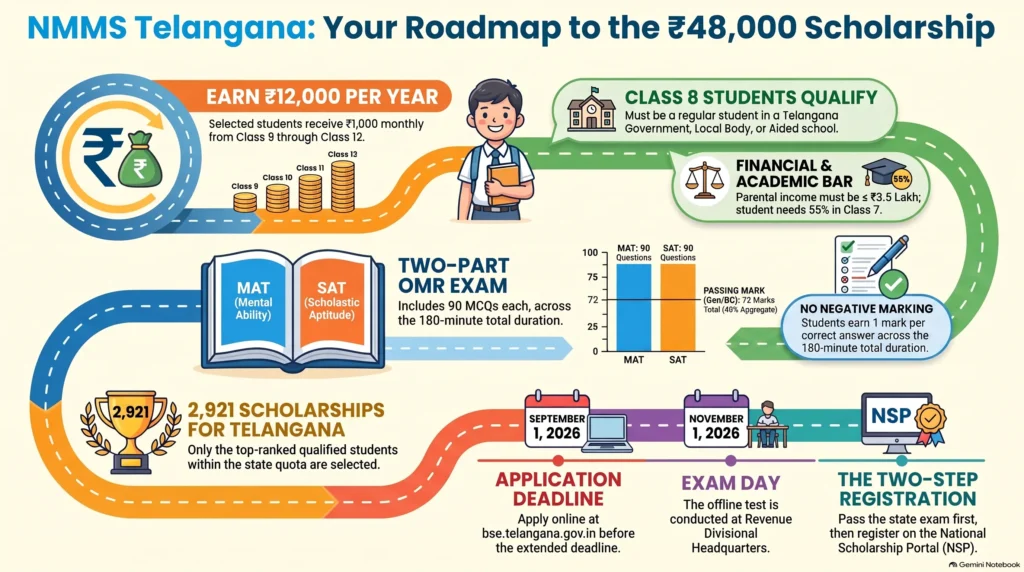
The financial incentive provided by the NMMS Scholarship is structured to provide steady, long-term support. Under this scheme, qualified scholars receive a scholarship of ₹12,000 per year (which breaks down to ₹1,000 per month). This financial aid is provided for four consecutive years, starting from Class 9 and continuing up to Class 12, creating a cumulative benefit of ₹48,000 per selected student.
The disbursement process is highly secure and transparent. The scholarship funds are directly credited to the student’s bank account through Direct Benefit Transfer (DBT) linked to the National Scholarship Portal (NSP). For a student to receive these funds smoothly, the following bank account conditions are strictly mandatory:
- The bank account must be in the student’s name. Joint accounts with parents or separate family accounts are not accepted.
- The account must be linked to the student’s Aadhaar card.
- The account must remain active and compliant with all Know Your Customer (KYC) rules.
Pro-Tip: The Aadhaar-School Mismatch Trap Every year, thousands of selected students in Telangana fail to receive their scholarship disbursements because of a minor administrative issue: mismatching spelling of their name between their school nominal rolls and their Aadhaar card. Ensure that the student’s name, date of birth, and father’s name are identical on the school register, the Aadhaar card, and the bank passbook. Any discrepancy will lead to rejection on the National Scholarship Portal (NSP) during verification.
NMMS Telangana Eligibility Criteria (2025–2026 & 2026–2027)
To sit for the state selection exam and qualify for the award, applicants must strictly meet the NMMS Eligibility Telangana criteria established by the Directorate of Government Examinations. These guidelines cover academic achievements, household income limits, and school classifications.
Academic Performance Requirements
The academic rules ensure that the scholarship reaches truly meritorious students who show consistent academic progress:
- Current Enrollment: The student must be currently studying as a regular student in Class 8 in a recognized government, local body (Zilla Parishad), or government-aided school in Telangana.
- Class 7 Performance: To qualify to sit for the registration exam, candidates must have secured a minimum of 55% marks in their Class 7 final examinations (for OC/BC categories).
- Relaxation for Reserved Categories: A 5% relaxation in minimum marks is provided to students belonging to Scheduled Castes (SC), Scheduled Tribes (ST), and Physically Handicapped (PH) categories. Therefore, these candidates only require a minimum of 50% marks in their Class 7 final exams.
Income Limits & MRO Certification
Because the scheme is intended to aid economically weaker sections, parental income is a critical metric:
- Income Boundary: The annual parental income from all sources must not exceed ₹3,50,000 per annum.
- Income Certification: For students whose parents are employed in private sectors or are self-employed, a valid Income Certificate issued by the Mandal Revenue Officer (MRO) of Telangana is mandatory. For parents working in government services, a formal employer salary certificate must be uploaded during application.
Eligible School Types vs. Subsidized Exclusions
The eligibility rules are highly specific about the type of school the student attends:
- Eligible Schools: The student must be studying in a Government, Local Body (Zilla Parishad), or Government-Aided school.
- Strict Exclusions: Students studying in private-unaided schools, municipal schools without government aid, or highly subsidized residential schools where the government already bears the entire expenditure (such as Kendriya Vidyalayas (KVs), Jawahar Navodaya Vidyalayas (JNVs), Sainik Schools, and state-run social welfare residential schools with boarding and lodging facilities) are not eligible to apply.
How to Apply for NMMS Telangana: A Step-by-Step Registration Guide
Applying for the NMMS Telangana scholarship requires attention to detail, as it involves a coordinated sequence between the candidate’s school, the District Educational Officer (DEO), and the DGE in Hyderabad.
Phase 1: The Two-Step Portal Registration Process
The most common point of confusion for applicants is the distinction between the two distinct portals involved in the scholarship lifecycle:
- Exam Registration: To compete for the scholarship, students must register and sit for the selection exam. This application is handled on the state portal at
bse.telangana.gov.in. - Scholarship Registration: Only after a student passes the state selection exam and their name is listed on the official merit list do they register on the National Scholarship Portal (NSP) at
scholarships.gov.into claim and receive their monthly funds.
Phase 2: Online School Submission & Fees
To submit the NMMS Telangana Application Form online, the process must go through the student’s school administration:
- The School Headmaster visits the official website of the Directorate of Government Examinations, Telangana at
bse.telangana.gov.in. - The headmaster logs into the NMMSE Online registration portal using the school’s unique DISE Code and Password.
- The student’s details (such as Aadhaar number, Class 7 marksheets, caste certificate, and the MRO-signed income certificate) are uploaded to the system.
- Examination Fee Payment:
- OC and BC Candidates: ₹100
- SC, ST, and PH Candidates: ₹50
- The fee must be paid online via SBI Collect, which is linked directly to the application portal.
Phase 3: Physical Document Submission & Verification
Once the online submission and fee payment are completed, the administrative workflow shifts offline:
- The Headmaster must download and print two copies of the nominal rolls and the generated candidate applications, along with the SBI Collect online fee receipts.
- The Headmaster attaches the printed applications, online payment receipts, and verified physical copies of certificates (Income, Caste, and Class 7 report card) and submits them to the District Educational Officer (DEO).
- The DEO verifies the physical records against the digital entries uploaded on the database.
- After verification, the DEO forwards the validated nominal rolls to the office of the Director of Government Examinations (DGE) in Hyderabad for hall ticket generation.
NMMS Exam Pattern & Topic-Wise Weightage
Preparation for the NMMS Scholarship exam is highly systematic. The exam is an objective, offline, OMR-based test lasting three hours, divided into two distinct parts: the Mental Ability Test (MAT) and the Scholastic Aptitude Test (SAT). Both parts are conducted on the same day with a short break in between.
Mental Ability Test (MAT) Structure & Core Topics
The MAT section is designed to evaluate a student’s cognitive, non-verbal, and meta-cognitive abilities rather than memorized curricular facts. It consists of 90 questions carrying 90 marks with a duration of 90 minutes.
The Board of Secondary Education, Telangana, publishes a precise, topic-wise question distribution. Solving questions within these exact ranges helps students prepare effectively:
| Syllabus Construct / Topic | Active Question Range | Total Items | Assessed Cognitive Competency |
|---|---|---|---|
| Number Series | Questions 1–5 | 5 | Linear progression and inductive logic |
| Incorrect Number Identification | Questions 6–10 | 5 | Anomaly detection in mathematical patterns |
| Letter Series | Questions 11–15 | 5 | Symbolic sequence tracking and memory recall |
| Coding and Decoding | Questions 16–20 | 5 | Cryptographic translation and systematic parsing |
| Venn Diagrams | Questions 21–25 | 5 | Logical set relationships and categorizations |
| Missing Characters | Questions 26–30 | 5 | Multi-variable grid analysis and spatial relation |
| Simple Mathematical Operations | Questions 31–35 | 5 | Precedence rules (BODMAS) and substitutions |
| Analogy | Questions 36–40 | 5 | Logical comparison mapping across domains |
| Classification | Questions 41–45 | 5 | Categorization and identifying outlier elements |
| Analytical Reasoning | Questions 46–50 | 5 | Complex geometric analysis and pattern counting |
| Sequential Order | Questions 51–55 | 5 | Property comparisons and positional hierarchies |
| Logical Sequence of Words | Questions 56–60 | 5 | Syntactic logic and chronological ordering |
| Blood Relations | Questions 61–65 | 5 | Kinship diagrams and relational deductions |
| Problem Solving | Questions 66–70 | 5 | Situational problem solving under constraints |
| Nonverbal Analogy | Questions 71–75 | 5 | Rotational geometric structures and visual comparisons |
| Embedded Figures | Questions 76–80 | 5 | Figure-ground segregation and pattern matching |
| Logical Reasoning | Questions 81–85 | 5 | Syllogistic logic and propositional reasoning |
| Cubes and Faces | Questions 86–90 | 5 | 3D spatial visualization and folding logic |
Scholastic Aptitude Test (SAT) Subject Distribution
The SAT section directly tests a student’s academic knowledge in Science, Social Studies, and Mathematics. The level of questions is strictly aligned with the academic standards of NCERT Class 7 and Class 8 syllabi. Like the MAT, the SAT consists of 90 questions carrying 90 marks to be completed in 90 minutes.
Crucially, there is no negative marking in either paper, meaning students should attempt all questions. The item-wise distribution of subjects is mapped out as follows:
1. Science (35 Questions Total)
- Physics (12 Questions – Q. 91 to 102): Focuses on basic concepts such as Heat, Motion and Time, Electric Current and its Effects, Light, Sound, Force, and Pressure.
- Chemistry (11 Questions – Q. 103 to 113): Covers Acids, Bases, and Salts, Physical and Chemical Changes, Synthetic Fibers, Coal and Petroleum, and Metals/Non-Metals.
- Biology (12 Questions – Q. 114 to 125): Includes Nutrition in Plants & Animals, Cell Structure and Functions, Respiration in Organisms, Reproduction in Animals, and Crop Production and Management.
2. Social Studies (35 Questions Total)
- History (10 Questions – Q. 146 to 155): Topics range from the Delhi Sultans and the Mughal Empire to the Establishment of Company Power, Weavers and Smelters, and the Indian National Movement.
- Geography (10 Questions – Q. 156 to 165): Focuses on Resources, Agriculture, Industries, Air, Water, Human Resources, and Life in the Deserts.
- Political Science / Civics (10 Questions – Q. 166 to 175): Covers Equality in Indian Democracy, State Government, the Indian Constitution, Parliament, and Social Justice.
- Economics (5 Questions – Q. 176 to 180): Evaluates knowledge on market systems, public services, and government economic presence.
3. Mathematics (20 Questions – Q. 126 to 145)
- Covers Rational Numbers, Linear Equations, Understanding Quadrilaterals, Squares and Square Roots, Cubes and Cube Roots, Exponents and Powers, Direct and Inverse Proportions, Mensuration, and Data Handling.
NMMS Telangana Selection Criteria & Merit List Cutoffs
Passing the examination is only the first step in the selection process. Because the scholarship involves central funding, candidates must understand how cutoff scores and quotas determine who receives the financial award.
Minimum Passing Marks vs. State Quotas
The evaluation process begins with a primary academic filter. To be eligible for the merit list, students must secure the minimum passing percentages across the combined scores of both papers:
- General / OBC / BC Categories: Must secure a minimum of 40% aggregate marks across both MAT and SAT papers taken together. This means scoring at least 72 out of 180 marks.
- SC / ST / PH Categories: Must secure a minimum of 32% aggregate marks across both papers. This means scoring at least 57.6 out of 180 marks.
The District Quota Bottleneck
Securing 40% or 32% marks does not guarantee the scholarship. The Government of India allocates a strictly fixed quota of scholarships to each state based on enrollment figures and child population. For Telangana, the centralized allocation is strictly capped at 2,921 scholarships.
The Directorate of Government Examinations compiles a merit list of candidates who have passed the exam. This list is categorized district-wise, reserving seats for different communities (SC, ST, BC, PH) as per the state’s reservation guidelines. Therefore, the actual cutoff to secure the scholarship in highly competitive urban districts (such as Hyderabad or Rangareddy) is typically much higher than the baseline 40% pass marks.
How to Check the NMMS Telangana Result Online
Once the official results are compiled, they are published directly on the state board’s portal:
- Visit the official website of the Telangana Board of Secondary Education at
bse.telangana.gov.in. - On the homepage, scroll down and click on the ‘NMMS’ section on the left-side menu.
- Click on the link titled “NMMSE December 2026-27 Selected Candidates List” or the appropriate selected candidates list for the cycle.
- This action opens a consolidated PDF file containing the list of provisionally selected candidates sorted by district.
- Press
Ctrl + Fon your keyboard and enter your Name or Exam Roll Number to verify your selection status. - The PDF will display details such as your District, Roll Number, Candidate Name, Father’s Name, School Name, and School Address.
- Download and save this PDF, as you will need it for verification during registration on the National Scholarship Portal.
Academic Retention Rules for Ongoing Scholarship Disbursement
Securing your name on the selection list is a monumental achievement, but maintaining the scholarship for the full four-year duration (Classes 9 to 12) requires strict compliance with ongoing academic and administrative rules.
Annual Renewal Requirements on the National Scholarship Portal (NSP)
To keep receiving the ₹12,000 annual scholarship, students must perform a renewal registration on the NSP portal (scholarships.gov.in) at the start of each academic year (for Classes 10, 11, and 12). If a student fails to renew their application within the stipulated dates announced by the Ministry of Education, the scholarship is permanently discontinued, and no claims for scholarship arrears will be entertained after 12 consecutive months from the end of the academic session.
Promotion and Class X Academic Benchmarks
The continuation of the NMMS Scholarship is tied to academic progress and attendance:
- Regular Promotion: The student must get regular promotion to the next higher class on their first attempt. If a student fails and repeats Class 9 or Class 11, their scholarship is terminated.
- No Private Schools: The scholar must continue studying in a recognized government, local body (Zilla Parishad), or government-aided school. Switching to a private-unaided school at any stage will invalidate the scholarship.
- The Class X Board Exam Hurdle: The most critical academic benchmark occurs at the end of Class 10. To continue the scholarship into Class 11 (higher secondary stage), scholars must secure a minimum of 60% marks in their Class 10 board examinations.
- SC/ST Relaxation: For Scheduled Caste (SC) and Scheduled Tribe (ST) students, a relaxation of 5% is permitted. They must secure a minimum of 55% marks in their Class 10 board exams to continue receiving the scholarship in Class 11 and 12.
Critical Systemic Challenges and Policy Insights
A deeper evaluation of the NMMS Telangana framework reveals several structural issues. While the program successfully supports academic achievement among disadvantaged students, these administrative and systemic vulnerabilities can limit its overall impact.
Institutional Dependency and Digital Discrepancies
The application process relies heavily on the administrative capacity of individual schools. To successfully register, students must rely on school staff to correctly upload documents and coordinates. In under-resourced rural schools, a lack of administrative time or digital familiarity can prevent eligible, high-performing students from registering on time, creating a barrier to entry before the exam even occurs.
Language Resource Gaps
While the exam is officially conducted in four languages (English, Telugu, Hindi, Urdu), high-quality preparatory guides, practice test banks, and comprehensive weightage directories are overwhelmingly published in English. This creates a resource discrepancy for regional language candidates who rely on local teachers’ forums to translate and compile practice materials. Providing centralized, bilingual question banks would significantly lower preparation barriers.
NMMS Telangana Frequently Asked Questions (FAQs)
Can private school students apply for the NMMS scholarship in Telangana?
No. Only regular students of Government, local body, and government-aided schools are eligible. Students studying in private-unaided schools, Kendriya Vidyalayas (KVs), Jawahar Navodaya Vidyalayas (JNVs), and state-funded residential schools with free boarding/lodging are strictly excluded.
Is there negative marking in the NMMS Telangana examination?
No. There is no negative marking in either the MAT or SAT sections. Each correct answer carries exactly one mark, so students should ensure they attempt all 180 questions on the OMR sheet.
What is the maximum family income limit to qualify for NMMS in Telangana?
The combined annual family income from all sources must not exceed ₹3,50,000. A valid income certificate issued by the Mandal Revenue Officer (MRO) is required to verify this limit.
How much is the examination fee for NMMS Telangana?
The examination fee is ₹100 for OC and BC candidates, and ₹50 for SC, ST, and PH candidates, payable online through SBI Collect.
Direct Links and Resources
- Official Board of Secondary Education, Telangana: bse.telangana.gov.in
- National Scholarship Portal: scholarships.gov.in
- Central Government Scheme Guidelines: NMMSS Revised Guidelines PDF
- Telangana Teachers’ Blog Portal: Telangana Social Studies Teachers’ Forum