For thousands of urban and rural families struggling to secure a permanent address in Telangana’s increasingly expensive housing market, owning a home can feel like an unreachable dream. Rent payments eat up monthly earnings, landlords can ask families to move on a whim, and a lack of collateral makes securing a formal bank loan nearly impossible.
To bridge this gap, the Telangana state government has launched its flagship social infrastructure program: the Indiramma Illu Housing Scheme (officially designated as Indiramma Indlu). Spearheaded by Chief Minister A. Revanth Reddy and Housing Minister Ponguleti Srinivasa Reddy, this massive welfare initiative has committed a staggering ₹22,000 crore to make the dream of a safe, secure, and permanent concrete (pucca) home a reality for the state’s most vulnerable citizens.
Whether you are a rural agricultural laborer, a resident of an urban slum, or a local community activist, navigating the rules, application procedures, and digital verification systems of this program is crucial to securing your benefits.
This ultimate guide will take you step-by-step through everything you need to know to apply, qualify, and check your status online for the Indiramma Illu scheme.
What is the Indiramma Illu Housing Scheme?
The Indiramma Illu scheme represents a major policy pivot in how Telangana delivers social welfare. Launched formally on March 11, 2024, under the newly elected Congress government’s “six guarantees” (the Abhayahastham program), it represents a return to a self-construction cash-grant model.
Applicant Classifications: L1, L2, and L3 Categories
To manage the state-wide rollout fairly, applicants are classified into three distinct tiers:
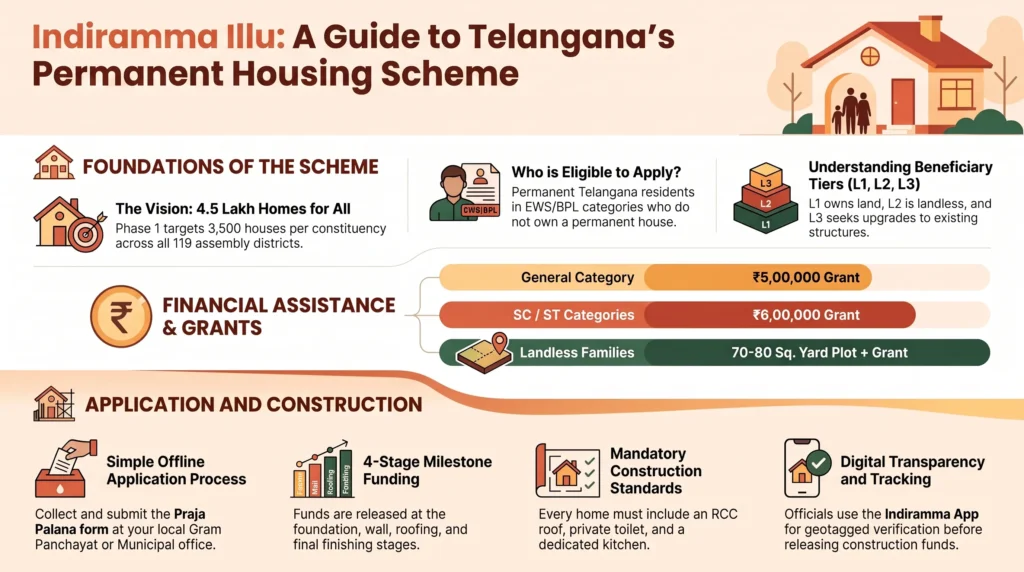
- Category L1 (Verified Landowners): Eligible citizens who own a piece of land but do not have a permanent structure. These families receive the highest priority for standalone construction grants.
- Category L2 (Landless & Homeless): Applicants who own neither land nor a house. The state provides them with a residential plot (typically 70 to 80 square yards) alongside the construction subsidy.
- Category L3 (Ineligible/Disputed): Applicants who already own a permanent home, have received previous state housing benefits after 1995, or fail physical verification. This category also includes applications caught in land boundary or ownership disputes.
Indiramma Illu Eligibility: Who Qualifies for the ₹5 Lakh Aid?
The state government has established rigorous eligibility criteria to ensure that the ₹22,000 crore budget reaches genuinely vulnerable households. To qualify for a housing grant, you must meet the following rules:
Essential Eligibility Checklist
- Telangana Residency: The applicant must be a permanent, verified resident of Telangana.
- Economic Status: The program targets the Economically Weaker Section (EWS) and Below Poverty Line (BPL) families. You must possess a valid Food Security Card (Ration Card).
- Housing Status: Neither the applicant nor any immediate family member should own a permanent concrete (pucca) house anywhere in India.
- Prior Welfare Exclusion: You must not have benefited from any previous government housing scheme (including INDIRAMA or 2BHK).
A Women-Centric Approach to Property Rights
In a progressive move toward gender-centric social security, ownership and registry documents under the scheme are issued exclusively in the name of the female head of the household. If a husband and wife apply together, joint registration is preferred, transferring property rights to the woman who is often left landless in rural economies. Priority is also carved out for widows, single unmarried women over a certain age, and disabled individuals.
Special Priority Categories
- Telangana Movement Activists: Families of individuals who actively fought or sacrificed their lives for Telangana statehood are entitled to a 250 square meter (or 250 square yard) residential site and prioritized construction funds.
- SC/ST Category Enhancements: While general applicants receive a ₹5,00,000 subsidy, SC/ST beneficiaries receive ₹6,00,000 to help offset rising material costs.
- Vulnerable Tribal Belts: The government has prioritized extremely vulnerable tribal groups, such as the Chenchu tribe. In Phase-1, 13,266 houses were sanctioned specifically for Chenchu families across the forested belts of Nagar Kurnool, Nalgonda, and Mahabubnagar.
CURE LIG Flats: The ₹6 Lakh Urban Apartment Revolution
While direct cash grants for standalone houses work beautifully in rural regions where land is plentiful, high-density urban areas like Hyderabad face severe land scarcity. To address this challenge, the government launched the “Indiramma Indlu-LIG Flats” urban extension on July 20, 2026.
What is the CURE Area?
The CURE—or Core Urban Region Economy—is a high-density urban zone primarily aligned with municipal wards within and around the Outer Ring Road (ORR) and Greater Hyderabad Municipal Corporation (GHMC) limits. The cabinet has approved a blueprint for 1,00,000 urban homes in the CURE area (70,000 Low Income Group and 30,000 Middle Income Group units).
The first phase consists of 7,680 LIG flats constructed as vertical, multi-storey apartment blocks (up to 10 floors) built on valuable government-owned land. The land itself, valued at ₹40 lakh to ₹60 lakh per site, is provided by the state completely free of cost and registered in the woman’s name.
The Co-Funding Model
Unlike the 100% subsidized rural model, the CURE urban apartments operate on a co-funded public-private cost-sharing mechanism:
- Total Estimated Cost: ₹11,00,000 per flat.
- State Subsidy: ₹5,00,000 per flat, paid directly to contracted builders.
- Beneficiary Share: ₹6,00,000, which selected applicants pay over a one-year construction cycle.
To apply, urban applicants must deposit an Earnest Money Deposit (EMD) of ₹10,000 through MeeSeva. If you are selected via the lottery system, this deposit is adjusted into your beneficiary share; if you are not selected, it is refunded in full.
The ₹6,00,000 beneficiary contribution is collected in four progress-linked installments:
- Installment 1: ₹1,00,000 (at the foundation/basement level).
- Installment 2: ₹2,00,000 (after completion of walls, doors, and windows).
- Installment 3: ₹2,00,000 (after concrete slab and structure completion).
- Installment 4: Remaining balance (during final finishing and painting).
CURE Flats Urban Eligibility Rules
To prevent real estate speculation and commercial exploitation, the government has enforced strict rules for urban applicants:
- City Residency: You must have been a resident of the GHMC/CURE area for at least 10 years.
- Local Property Prohibition: You must not own any house, flat, or plot within the ORR/CURE limits.
- Resale Restriction: Allotted LIG flats come with a 10-year resale ban, meaning you cannot sell the property for a decade (though you can mortgage it with banks to secure a home loan).
First-Phase Urban Project Locations
The 7,680 first-phase flats are distributed across 16 Assembly constituencies, with exactly 480 LIG units earmarked for each location:
- Rajendranagar: Mylardevpally
- Maheshwaram: Jalpally
- Serilingampally: Raidurgam
- Ibrahimpatnam: Bandlaguda LIG Colony
- Malkajgiri: Kowkur
- Nampally: Red Hills (beside HMWSSB office and near Niloufer Hospital)
- Khairatabad / Jubilee Hills: Hakeempet Dargah & Near MLA Colony
- Karwan: Kulsumpura
- Bahadurpura: Nandi Musliguda
- Amberpet: City Police Lines
- Kukatpally: KPHB Colony
- Medchal: Pocharam LIG Colony
- Quthbullapur: Gajularamaram
- Sanathnagar: Patigadda
- Secunderabad Cantonment: Mahendra Hills near Marredpally
- Malakpet: Gaddiannaram near R&B Quarters
Step-by-Step Guide to Applying for Indiramma Illu
To prevent administrative delays and ensure accessible registration for less-educated or rural applicants, the government accepts applications primarily offline.
How the Offline Application Works
- Step 1: Get the Form: Collect the official Praja Palana application form free of cost from your local Gram Panchayat, Gram Sabha, or Municipal Ward office. Alternatively, you can download the PDF from the official Telangana state portal.
- Step 2: Complete the Details: Carefully fill out your personal information, family member details, date of birth, Aadhaar card number, and white Ration Card number.
- Step 3: Select the Scheme: On the “Abhayahastham Guarantee Schemes” checklist page, tick the box for the Indiramma Housing Scheme. If you possess land, check the L1 box; if you are landless, check the L2 box.
- Step 4: Attach Mandatory Documents: You must attach clear photocopies of the following papers:
- Aadhaar Card (mandatory for identity)
- White Ration Card / Food Security Card (mandatory for income verification)
- Income Certificate issued by the Tahsildar
- Caste/Tribe Certificate (if claiming SC/ST status or tribal benefits)
- Land Ownership Proof (Pattadar Passbook or registered land deed for Category L1)
- Copy of Bank Passbook first page (with IFSC details to facilitate direct benefit transfer)
- Recent Passport-size Photographs
- Step 5: Submit and Collect Receipt: Hand in your completed form at your local government ward or panchayat office. Make absolutely sure you collect your stamped and signed Praja Palana Application Receipt. This receipt contains your unique application number, which is required to track your status.
How to Check Your Indiramma Illu Application Status Online
Once you have submitted your Praja Palana form, your data is synchronized with central databases managed by the Centre for Good Governance (CGG) in Hyderabad. Checking your status is simple and transparent.
Step-by-Step Online Status Check Guide
- Step 1: Visit the official Indiramma Indlu tracking portal at
indirammaindlu.telangana.gov.in. - Step 2: On the homepage, navigate to the “Application Search” tab.
- Step 3: The system will display search fields. You can search by entering any one of the following identifiers:
- Aadhaar Number
- Registered Mobile Number
- Application ID (from your receipt)
- FSC (Food Security Card) Number
- Step 4: Click the “Search” or “Go” button.
- Step 5: Your real-time dashboard will appear on the screen. It will display:
- Your personal details, district, and village
- Your assigned beneficiary category (L1, L2, or L3)
- Whether a physical land survey has been completed
- The name and mobile number of your assigned field surveyor
- Your current application level
Understanding the Status Levels
As your application progresses through administrative review, your online status will transition through five distinct levels:
- Application Submitted: Your form has been digitized and entered into the CGG database.
- Under Verification: Field officers have been assigned to verify your residential status and land coordinates.
- Approved: The local committee of village secretaries and mandal officers has verified your eligibility and cleared your file.
- Sanctioned: An administrative sanction has been issued, confirming your funding.
- Payment Released: Construction installments have been credited directly to your bank account via DBT.
The Digital Verification Process (The CGG Mobile App)
To prevent the fake profiles and duplicate claims that plagued previous housing schemes, the government has built a robust digital tracking system. Field surveys are executed using the Indiramma Indlu Mobile App.
This app, developed by CGG, features strict security controls:
- IMEI Device Locking: Surveyor accounts are strictly bound to their device’s unique IMEI number and registered phone. Access requires multi-factor OTP validation to prevent fake verification records.
- Geo-Tagging: During the baseline survey, the app captures the exact GPS coordinates of the plot. Future payments are geographically locked to these coordinates, ensuring funds are only released for construction on the verified site.
- AI Photograph Auditing: Built-in artificial intelligence scans the metadata and structural elements of uploaded construction photos. It verifies that foundation, wall, and roof milestones have actually been reached before releasing subsequent funds.
- Random Audits: Before final selection lists are published at Gram Sabhas, local Block Development Officers (MPDOs) must conduct a mandatory 5% random cross-check on both approved and rejected applications to ensure digital accuracy.
Comparative Analysis: Indiramma Illu vs. Double Bedroom (2BHK) Dignity Housing
Telangana’s transition from the previous BRS administration’s 2BHK Dignity housing model to the current Congress administration’s Indiramma Illu scheme highlights a fundamental debate on social housing design.
The table below provides a side-by-side comparison of the technical, structural, and financial realities of the two initiatives.
| Structural Feature | Indiramma Housing Scheme (Current Model) | Double Bedroom (2BHK) Housing Scheme (Previous Model) |
|---|---|---|
| Primary Delivery Model | Beneficiary-Led Self-Build: Beneficiaries manage standalone construction (Rural); Co-Funded Urban Apartments: Contractors build multi-storey complexes (CURE). | State-Constructed Turnkey: Central contractors build and deliver fully finished turnkey apartment complexes. |
| Financial Assistance & Subsidies | Rural: ₹5 Lakh for general, ₹6 Lakh for SC/ST (100% state subsidy). CURE Urban: ₹5 Lakh state subsidy + ₹6 Lakh beneficiary contribution. | 100% Fully Subsidized: Completely funded by the state. Beneficiaries do not make any financial contribution or take loans. |
| Land Ownership Requirement | Applicants must own land (L1) or receive government-allotted plots (L2). | Built on pooled government land or cleared urban slums; no prior plot ownership required. |
| Unit Dimensions | Minimum carpet area of 323 square feet (approx. 400 sq. ft built-up area). | Standard plinth area of 560 square feet (including common areas). |
| Room Configuration | 1 BHK: One bedroom, hall, kitchen, and toilet. (Revised urban rules allow G+1 expansion on small plots). | 2 BHK: Two bedrooms, hall, kitchen, and two bathrooms/toilets. |
| Execution Rate & On-Ground Delivery | High Efficiency: 2,90,000 houses grounded out of 3,00,000 Phase-1 rural allocations as of May 2026. | Heavy Backlogs: Out of 1,52,000 promised units, only approximately 63,000 were completed and delivered. |
| Ownership Registration | Registered exclusively or primarily in the woman’s name to transfer family asset security. | Allotted in the housewife’s name to encourage female homeownership. |
Frequently Asked Questions (FAQ)
How can I check my Indiramma Illu application status online?
To check your status, visit the official tracking portal at indirammaindlu.telangana.gov.in. Navigate to the “Application Search” menu and search using your Aadhaar card number, registered mobile number, unique application ID, or Ration Card (FSC) number. Your real-time dashboard will instantly display your verification level.
What is the difference between L1, L2, and L3 categories?
- Category L1: Eligible applicants who own land but do not have a permanent structure. They receive the highest priority for standalone construction cash grants.
- Category L2: Homeless and landless families. They are allotted a residential plot (70-80 square yards) and construction funds.
- Category L3: Applicants who already own a permanent home or fail eligibility audits.
Is there any fee or deposit required to apply for CURE LIG Flats?
Yes. CURE urban flats require an Earnest Money Deposit (EMD) of ₹10,000 submitted via MeeSeva. If you are selected via the lottery system, this deposit is adjusted into your beneficiary share; if you are not selected, it is refunded in full. General offline applications for standalone rural/urban houses are completely free of cost.
Can I sell my allotted CURE LIG Flat if I move?
No. The allotted flats come with a 10-year resale ban, meaning you cannot sell or transfer the property for a decade. However, you can use the flat as collateral to secure housing loans from banks.
What should I do if my name is missing from the 2025-2026 sanction list?
If your name is missing, you should:
- Re-check your eligibility criteria and ensure your family annual income is within BPL limits.
- Visit your nearest MeeSeva or Citizen Service Centre to verify that your digitized data has no errors.
- Visit your local Gram Panchayat or Municipal ward office to verify and correct errors in your Praja Palana form.
- File an official grievance online under the “Grievance” tab on the official Indiramma Indlu website.
Conclusion
The Indiramma Illu scheme represents a major shift in Telangana’s approach to social equity and urban planning. By committing ₹22,000 crore and establishing strict RCC construction standards, the state is moving beyond temporary relief to provide permanent residential assets for 4.5 lakh families. While land availability and documentation remain key challenges, integrating digital tracking and prioritizing women-centric ownership ensures a transparent and impactful delivery mechanism. Telangana’s commitment to providing ₹5 lakh in financial aid for home construction is set to redefine the affordable housing landscape through FY2027 and beyond.