If you are a state government employee, retiree, or journalist in Telangana, navigating the healthcare system has historically meant dealing with complicated paperwork, out-of-pocket expenses, and long reimbursement delays. However, the landscape has dramatically shifted.
The Government of Telangana formally launched the New Employees Health Scheme (NEHS) on July 17, 2026. Formulated after extensive negotiations with employee and retiree joint action committees, this revamped scheme completely moves away from legacy reimbursement systems to establish a robust, transparent, and completely cashless health insurance safety net.
Whether you are trying to register, log into the portal, download your digital health card, or add a dependent, this complete guide covers everything you need to know in simple, conversational language.
What is the New Employees Health Scheme (NEHS) in Telangana?
At its core, the New Employees Health Scheme (NEHS) is a state-sponsored, cashless healthcare programme designed to protect government staff and their families from financial distress during medical emergencies. Under this scheme, you do not have to pay upfront for surgeries or hospitalisations at network hospitals. Instead, the healthcare trust handles the billing directly with the hospital.
Replaced Systems and the APIMA Rules of 1972
Historically, public sector medical benefits in the region were governed by the legacy Andhra Pradesh Integrated Medical Attendance (APIMA) Rules of 1972. Under that old system, employees had to pay for advanced medical treatments out of their own pockets and then submit physical claims through a rigid, slow-moving bureaucratic pipeline.
This frequently led to months of delay, high claim rejection rates over minor clerical errors, and significant financial vulnerability. In fact, many employees were forced to take high-interest loans just to clear hospital bills. The NEHS officially replaces this legacy reimbursement model with real-time, trust-managed cashless hospitalisation.
Core Highlights of the Cashless Trust System
- Total Cashless Model: Covers end-to-end hospitalisation costs with zero upfront out-of-pocket expenses for approved treatments.
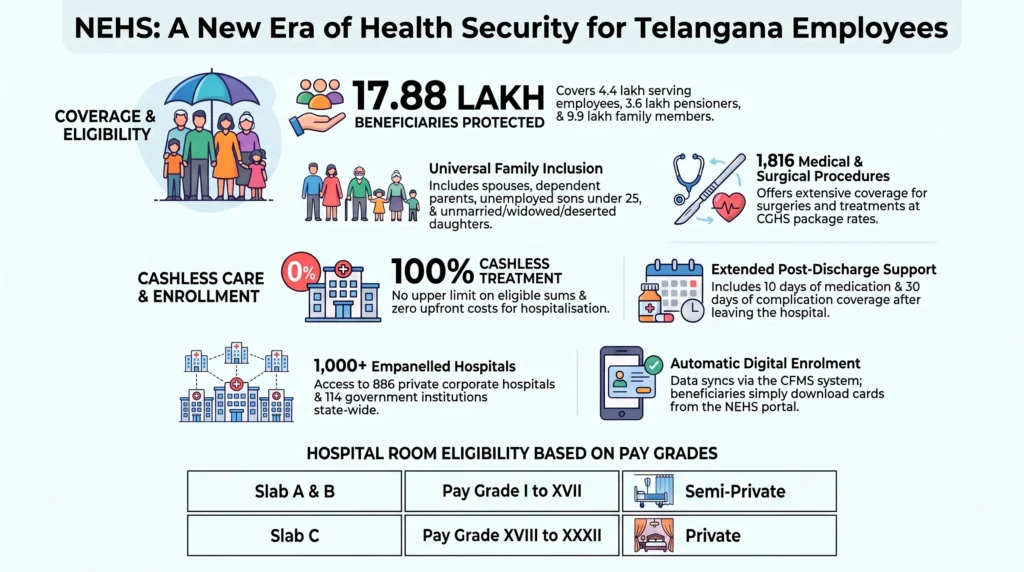
- Wider Hospital Choice: Access to 1,000 empanelled hospitals, including 886 private facilities and 114 government hospitals.
- Day-One Coverage: Unlike commercial health insurance, there are no waiting periods or exclusions for pre-existing diseases (PEDs)—you are covered from your very first day on the job.
- Post-Discharge Care: Includes 10 days of free medicines post-discharge and coverage for clinical complications for up to 30 days.
- Follow-Up Packages: Provides up to 1 year of follow-up services (such as consultations, investigations, and drugs) for chronic or major surgical conditions.
Board of Trustees & Governance of the Employees Health Care Trust (EHCT)
To ensure the scheme is run transparently and doesn’t run into the administrative hurdles of the past, the Telangana government has reconstituted the Employees Health Care Trust (EHCT) board. Instead of outsourcing the health fund to a third-party commercial insurance company, the EHCT administers and underwrites the scheme directly as a self-funded health pool.
Composition of the EHCT Board
The trust is governed by a balanced 30-member Board of Trustees chaired directly by the state’s Chief Secretary. The board’s composition is structured as follows:
- 17 Senior Government Officials: Representing vital administrative departments like Finance, Health and Medical, Education, Home, GAD, Municipal Administration, and Panchayat Raj, with the trust’s CEO serving as the member-convener.
- 10 Active Union Representatives: Nominated directly from recognized state government employee unions to give workers a direct voice in scheme management.
- 3 Retired Pensioner Representatives: Nominated from retired officer and pensioner associations to advocate for retirees.
Union Grievances & Labor Context
While the cooperative trust structure has been widely praised, it has also faced some political and labor hurdles. The Telangana State Contributory Pension Scheme Employees Union (TSCPSEU), which represents over 2.6 lakh public sector employees, has actively protested their exclusion from the trust’s governing board.
Union leaders have flayed this neglect, pointing out that because lower-earning CPS retirees draw significantly lower monthly pensions, a flat 1.5% deduction is disproportionately harder for them to bear without sliding-scale adjustments or customized contribution rates.
How the Money Works: Contributions, Slabs, and Deductions
The financial engine behind the NEHS Telangana is a jointly funded co-contributory model managed directly by the healthcare trust.
The 1.5% Basic Pay & Pension Deduction
Under GO Ms No. 79, Drawing and Disbursing Officers (DDOs) are mandated to deduct a flat 1.5% of the basic pay of active serving employees and 1.5% of the basic pension of retirees on a monthly basis.
The Telangana Government matches this payroll deduction rupee-for-rupee with an equal state contribution. Together, the combined employee contributions and the government’s matching share are projected to generate a sustainable health fund pool of Rs. 1,056 crore per year (Rs. 528 crore from each side).
Anti-Duplication Rules & Spouse Exemptions
To prevent families from being double-charged, the policy outlines strict anti-duplication guidelines:
- Dual-Employee Couples: If both husband and wife are state government employees, the 1.5% deduction is strictly restricted to a single younger individual.
- Pensioner & Employee Couples: In households where one spouse is an active employee and the other is a pensioner, the deduction is only made from one of them.
- Multiple Pensions: If a retired employee draws both a service pension and a family pension, only a single deduction is permitted.
DDOs are required to verify family dependency records using the Integrated Financial Management Information System (IFMIS-HRMS). The trust has also ordered that any excess or duplicate deductions made previously must be refunded to the employees.
Clearing the Legacy Medical Reimbursement Backlog
To restore faith in public welfare administration, the current administration has taken a major step to resolve historical financial liabilities. The state government is releasing a phased allocation of Rs. 2,000 crore per month to clear a massive Rs. 10,000 crore backlog in pending medical reimbursement bills left unpaid by the previous administration.
Who is Eligible for EHS Telangana? (Inclusions and Exclusions)
Eligibility for the New Employees Health Scheme is clearly defined by the health trust. The program covers approximately 8 lakh government employees and pensioners, along with nearly 29.8 lakh of their dependent family members, translating to 17.88 lakh core beneficiaries.
Serving Employees, Retirees, and Journalists
The following categories are fully eligible for the cashless healthcare safety net:
- Serving Employees: All regular State Government employees (as defined under Fundamental Rules) and provincialised employees of local bodies (such as municipalities and panchayats).
- Pensioners: Service pensioners, family pensioners, and re-employed service pensioners.
- Journalists: Working journalists across the state who are verified and approved by the District Public Relations Officer (DPRO).
Who Counts as a Dependent?
To protect your immediate family, you can add dependent members to your EHS card, provided they are financially dependent on you:
- Spouse: One legally wedded spouse.
- Parents: Financially dependent biological or adoptive parents (you can cover one set, but not both).
- Unemployed Sons: Must be under the age of 25 years.
- Dependent Daughters: Must be unmarried, divorced, widowed, or deserted, and completely unemployed.
- Disabled Children: Legitimate, adopted, or stepchildren of any age who suffer from physical or intellectual disabilities that make them permanently unfit for employment.
Absolute Exclusions from the Scheme
The scheme is highly targeted and strictly excludes the following categories:
- AIS Officers: All India Service (AIS) officers and AIS pensioners.
- Other Departmental Schemes: Anyone covered under specialized department plans (such as Central Government Health Scheme/CGHS, Railways, ESIS, RTC, Aarogya Bhadratha of the Police Department, or Aarogya Sahayatha of the Prohibition and Excise Department).
- Casual Labor: Temporary, casual, or daily-wage workers.
- Extended Family: Independent children, in-laws, and biological parents if adoptive parents are already registered (or vice versa).
- Law Officers: Public Prosecutors, Advocate Generals, State Counsel, and Government Pleaders.
Clinical Coverage, Covered Diseases, and Ward Slabs
The NEHS provides comprehensive clinical security, ensuring that you don’t face unexpected billing limits during major health scares.
1,816 Medical & Surgical Packages
The scheme covers 1,816 pre-defined medical and surgical procedures aligned with Central Government Health Scheme (CGHS) package rates. This comprehensive package list covers tertiary super-specialty interventions such as:
- Cardiovascular and Open-Heart Surgeries
- Neurosurgery and Brain Procedures
- Oncology Treatments (including Chemotherapy, Radiotherapy, and Cancer Surgeries)
- Renal Care (including Regular Kidney Dialysis and Kidney Transplants)
- Organ Transplants and Joint Replacements
Crucially, there is no upper financial limit or cap on the total covered expenses for these listed treatments. The trust bears the full eligible package cost regardless of how high it goes, which is a major lifesaver compared to commercial insurance plans.
Room Rent Limits & Ward Entitlements (Slabs A, B, and C)
Your hospital room entitlement during an inpatient stay is directly determined by your official pay grade slab:
| Employee Slab | Pay Grade / Scale | Entitled Ward Type |
|---|---|---|
| Slab A | Pay Grades I to IV | Semi-Private Ward |
| Slab B | Pay Grades V to XVII | Semi-Private Ward |
| Slab C | Pay Grades XVIII to XXXII | Private Ward |
Outpatient Chronic Disease Management & Wellness Centers
Unlike typical commercial plans that only cover hospitalization, the NEHS features a dedicated outpatient framework to help manage long-term health issues. The trust operates 36 specialized wellness centres across Telangana (consisting of 12 existing clinics and 24 newly constructed facilities in underserved districts).
These wellness centres provide free doctor consultations, diagnostic tests, and branded medicines for major non-communicable diseases (NCDs). Covered chronic conditions include:
- Diabetes Mellitus (Types 1 and 2)
- Hypertension and Coronary Artery Disease
- Chronic Obstructive Pulmonary Disease (COPD) and Bronchial Asthma
- Epilepsy and Chronic Psychiatric Disorders
- Renal Failure and Chronic Kidney Disease
To make access even easier, district and teaching hospitals host exclusive special clinics for EHS patients from 2:00 PM to 4:00 PM on weekdays. In these clinics, specialist consultants are paid Rs. 50 (broad specialty) or Rs. 100 (super-specialty) directly by the trust for every registered EHS patient they treat.
Furthermore, all employees and retirees over the age of 40 are eligible for a completely free comprehensive annual health checkup at any notified network hospital.
Navigating the Official Portals (nehs.telangana.gov.in)
The entire NEHS platform is digital, meaning you can handle logins, enrollment, and card downloads right from your computer or phone.
Logging in as an Employee
For active, serving employees, no separate registration is required. Your Drawing and Disbursing Officer (DDO) automatically uploads your service details, Aadhaar, and payroll data through the state’s Comprehensive Financial Management System (CFMS) directly to the trust.
To log into your dashboard:
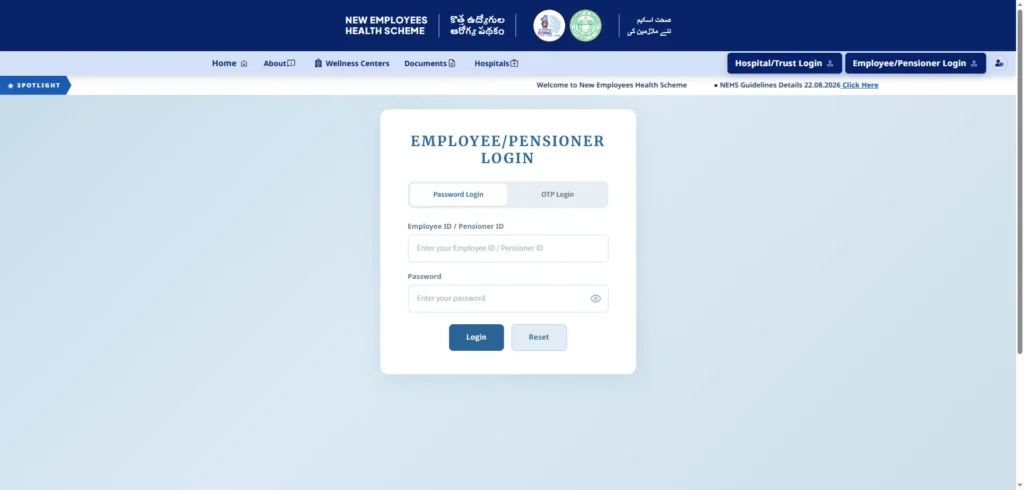
- Go to the official Employee Health Scheme portal at
nehs.telangana.gov.in(or the legacy portalehf.telangana.gov.in). - Click on the ‘Sign-in’ button at the top-right corner of the homepage.
- Select the ‘Employees’ option.
- Enter your Employee ID as the username.
- Enter your password (first-time users can use their Employee ID as their temporary password and reset it immediately).
Pensioner Registration and Enrollment Guide
If you are a retired employee, you must submit an online enrollment form to activate your health card. Here is the step-by-step registration guide:
- Gather Your Documents: Before starting, prepare scanned copies of your Aadhaar card, ICAO-compliant passport photos (45mm x 35mm, under 200KB), disability certificates (if applicable), and birth certificates for dependents under the age of 5.
- Log In: Go to
nehs.telangana.gov.in, click on the ‘Pensioners’ tab, and sign in. If you do not have your credentials, you can retrieve them from your Sub Treasury Officer (STO), Assistant Treasury Officer (ATO), or by calling the helpline at 104. - Fill the Form: Open the enrollment application and fill in your department head, STO/APO, and district.
- Upload & Add Dependents: Upload your prepared documents, add your dependent family members, and click ‘Save’.
- Submit for Approval: Click ‘Submit Application’ to receive an Enrollment ID via SMS. Print out the generated application form, sign it, scan it, and upload the signed copy. Finally, click ‘Submit Application for Approval’ and wait for your STO/APO to verify and approve it.
Downloading Your Digital Health Card
Once the trust approves your data, you can quickly download your permanent health card:
- Log into the portal using your username and password.
- Click on the ‘Registration’ tab and select ‘Download Health Card’.
- Verify that your family details and photographs are correct.
- Click ‘Print’ to save the digital health card as a PDF or print it out directly. If you don’t have a printer, you can get it printed and laminated at any Mee Seva centre for a nominal fee of Rs. 25.
How to Add Dependents in the EHS Portal (Step-by-Step)
If you get married, have a child, or need to add a dependent parent, you can easily update your card on the portal. Here is how to do it:
- Step 1: Log into
nehs.telangana.gov.inusing your Employee or Pensioner ID. - Step 2: Click on the ‘Registration’ tab in the top-left menu.
- Step 3: Select ‘Initiate New/Rejected Beneficiaries’.
- Step 4: You will be redirected to the ‘Beneficiaries Worklist’ page. Click on ‘Add New Beneficiary’.
- Step 5: Fill in the demographic details of your dependent family member.
- Step 6: Upload the required document proofs:
- For children under 5: Scanned copy of their Birth Certificate.
- For family members over 5: Scanned Aadhaar card and a recent passport-sized photograph.
- Step 7: Click ‘Save’ to secure the data.
- Step 8: Review the information on the next page, then click ‘Submit’ to send the request to the Aarogyasri Trust for approval. Once approved, the new dependent will show up on your digital health card.
Patient Flow at Network Hospitals
To use your benefits, you simply need to present your permanent digital health card at any empanelled hospital. Here is exactly how the inpatient cashless treatment flow works:
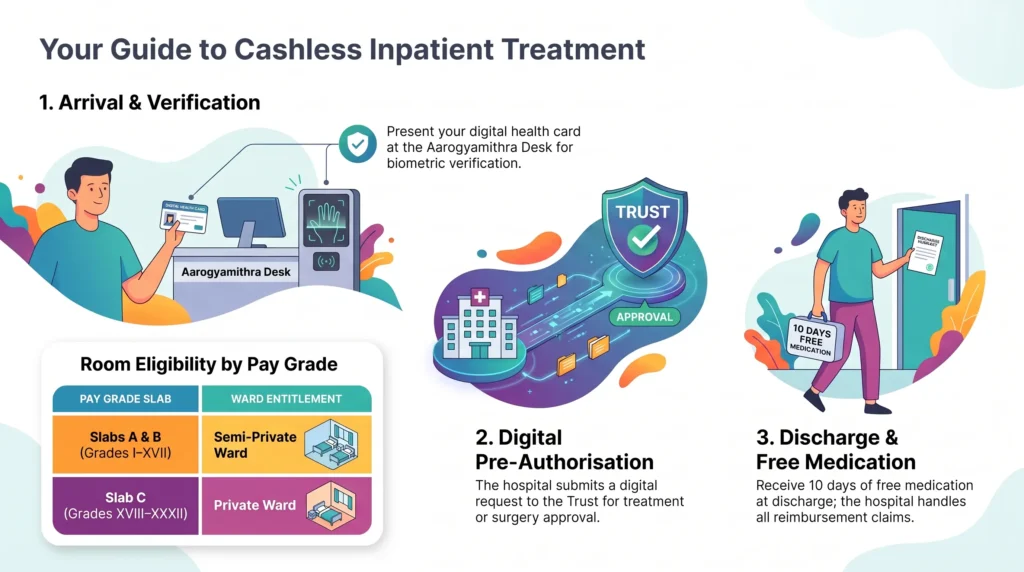
Beneficiaries do not have to handle claim papers, arrange upfront cash, or negotiate with the hospital.
Emergency Treatment & Non-Network Hospital Policy
If you suffer a sudden, life-threatening emergency or accident, you can be admitted to a nearby non-empanelled hospital. In these emergency scenarios, you can pay for the treatment upfront and file a reimbursement claim with the trust within 6 months (or up to 8 months in exceptional circumstances like coma or death). Your reimbursement will be scrutinized and settled based on standard EHS package rates.
However, if you choose to get treated at a non-network hospital for a routine, non-emergency procedure, the reimbursement is capped:
- The total claim is strictly restricted to 75% of the package rate of a similar procedure in the lowest-grade network hospital.
- You will have to pay the remaining 25% balance plus any non-payable administrative consumables (such as gloves, PPE kits, or registration fees) entirely out of your own pocket.
EHS Customer Care, Helpline, and Grievance Contacts
If you run into any issues during hospitalization, face a technical error on the portal, or have a grievance regarding a hospital refusing cashless service, you can reach out directly to the trust:
- 24/7 Toll-Free Helpline: Dial 104 from any phone.
- Grievance Mobile Contacts: Call
+91-8333817408or+91-8333817470. - Official Grievance Email:
ehfts@aarogyasri.gov.in. - Physical Trust Headquarters: Aarogyasri Health Care Trust, D.No. 8-2-293/82a/acht, Road No. 46, Jubilee Hills, Hyderabad – 500033.
- Direct Office Phone:
040-23547107| Fax:040-23555657.
Frequently Asked Questions (FAQs)
Is there an upper limit on how much EHS Telangana will pay for a treatment?
No. Unlike commercial insurance policies or neighboring state models, the Telangana Employees Health Care Trust has not fixed any upper limit on the financial coverage provided for listed therapies. The trust covers the entire approved CGHS package tariff for your surgery.
Can I add my in-laws to my EHS card?
No. Under the trust’s eligibility guidelines, in-laws of either the serving employee or the pensioner are strictly excluded and cannot be registered as dependent beneficiaries.
What is the EHS customer care number?
The official toll-free helpline is 104, which is available 24/7 across the state. If you need specialized claim assistance, you can also email the trust directly at ehfts@aarogyasri.gov.in.
Can an unemployed son over the age of 25 receive NEHS benefits?
No, unemployed sons over 25 are not eligible. However, if your son suffers from a permanent physical or mental disability that makes him unable to work, he can be covered with no age restriction, provided you upload a valid disability certificate.
What should I do if both my spouse and I are government employees?
If both spouses are state employees (or one is an employee and the other a pensioner), you should submit your family details to your DDO. DDOs are instructed to deduct the 1.5% contribution from only one younger spouse. If you have been double-deducted, the excess amount will be refunded.
Where can I download the Employee Declaration Form?
You can download the form directly from the homepage of the official portal (nehs.telangana.gov.in) under the tab labeled ‘Declaration Form by Employee’. This must be printed, attested by a Gazetted Officer, and scanned for upload.