Unemployment and structural underemployment remain persistent socioeconomic challenges in Telangana. Historically, the state’s transition toward a services-driven economy has left a massive portion of both educated and uneducated youth outside the formal job market. To address this systemic vulnerability and foster micro-entrepreneurship, the Government of Telangana formally introduced the Rajiv Yuva Vikasam Scheme under Government Order (G.O.) Ms. No. 7. Conceived under the joint leadership of Chief Minister A. Revanth Reddy and Deputy Chief Minister Mallu Bhatti Vikramarka, this flagship initiative represents a monumental subnational funding commitment.
However, since its grand announcement in early 2025, the program’s real-world rollout has encountered a complex web of administrative, fiscal, and political obstacles, leaving millions of applicants in state-wide limbo.
This comprehensive guide serves as an authoritative resource. We will unpack the structural details of the scheme, contrast the co-existing subsidy models, outline the step-by-step online registration process, examine a real-life beneficiary case study, analyze the macro-fiscal constraints delaying implementation, and discuss strategic policy pathways forward.
What is the Rajiv Yuva Vikasam Scheme in Telangana?
At its heart, the Rajiv Yuva Vikasam Scheme is a major intervention designed to turn unemployed young citizens into active business owners. Rather than handing out one-time grants or relying on formal public sector hiring, the state is trying to cultivate a vibrant culture of local self-reliance and micro-entrepreneurship.
Bridging the Youth Unemployment Gap
In Telangana, labor market imbalances heavily affect historically marginalized populations. The scheme was designed to address this challenge by providing marginalized youth with the capital assets they need to start sustainable small businesses. By enabling young people to become job creators rather than job seekers, the state hopes to reduce youth unemployment, ease household mental stress, and support rural economies.
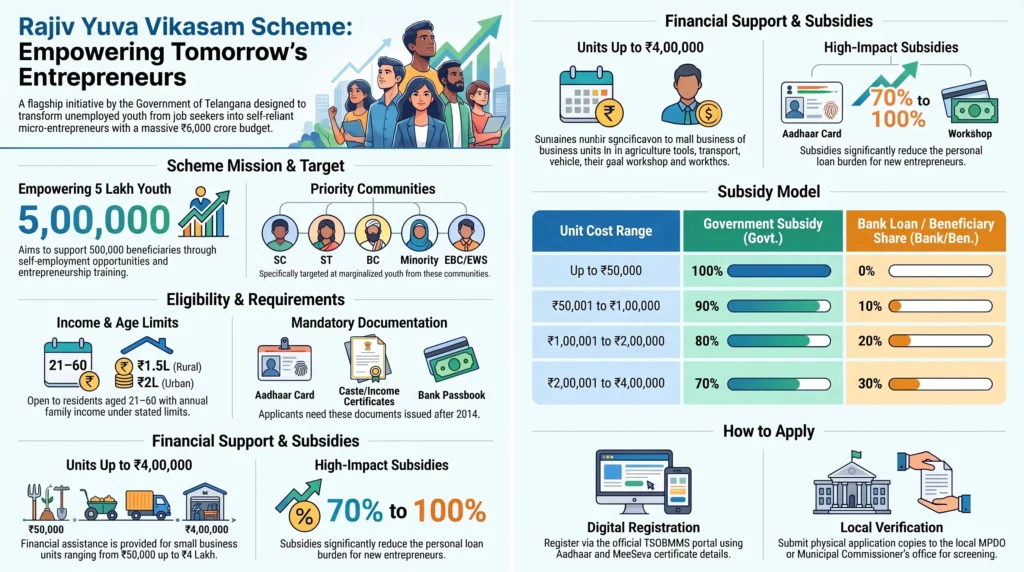
The program was launched with an expected outlay of ₹6,000 crore to benefit approximately 500,000 individuals across the state’s 119 Assembly constituencies. Various welfare corporations representing Scheduled Castes (SC), Scheduled Tribes (ST), Backward Classes (BC), and Minority communities serve as the primary implementing agencies.
Clearing the Confusion: 2015 Skill Training vs. 2025 Self-Employment Loans
One of the biggest pain points online is the duplicate nomenclature of “Rajiv Yuva Vikasam.” Over the last decade, the Telangana government has run two distinct initiatives carrying identical names. This has created massive confusion, so let’s separate them:
1. The 2015 Skill Training Initiative (Active & Verified in 2026)
- Launch Year: Originally rolled out in 2015, verified as still running in mid-2026.
- Core Benefit: Focuses on free vocational and skill development training across ITI, TSSC, and industry-aligned trades.
- Stipend & Perks: Provides a monthly stipend of ₹3,000 during the training duration, alongside free hostel facilities for outstation candidates.
- Target Demographics: Domicile youth of Telangana aged 18 to 35 years who have passed at least Class 10 (SSC).
- Income Ceiling: Annual family income must be below ₹5,00,000 (₹5 Lakh).
- Portal: Administered through the Telangana State Public Service Commission platform at tspsc.gov.in.
2. The 2025 Self-Employment Loan Scheme (Subject to Current Hold)
- Launch Year: Formally launched in March 2025 under G.O. Ms. No. 7.
- Core Benefit: Focuses on capital asset capitalization, providing bank-linked concessional loans and heavy government subsidies to start micro-enterprises.
- Financial Outlay: Offers units costing up to ₹3,00,000 (₹3 Lakh) or ₹4,00,000 (₹4 Lakh) depending on the implementing corporation.
- Target Demographics: Unemployed youth from marginalized communities aged 21 to 55 years for non-agricultural units, and 21 to 60 years for agricultural and allied sector units.
- Income Ceiling: Capped strictly at ₹1,50,000 (₹1.5 Lakh) per annum in rural areas and ₹2,00,000 (₹2 Lakh) in urban areas.
- Portal: Administered through the Online Beneficiary Management and Monitoring System (OBMMS) at tgobmms.cgg.gov.in.
Eligibility Criteria for the Self-Employment Loan
To ensure that precious government funds are used properly, the Telangana government has put several strict eligibility rules in place. If you plan to apply when the registration window reopens, you must meet the following criteria:
Age Limits and Vocational Sectoring
Your age limit under the self-employment program depends entirely on the economic sector you select:
- Agricultural and Allied Sectors: Applicants must be between 21 and 60 years of age.
- Non-Agricultural Sectors: Applicants must be between 21 and 55 years of age.
Domicile, Family Income, and Ration Card Rules
- Telangana Domicile: You must be a permanent resident of Telangana State.
- Annual Family Income limits:
- Rural Areas: Family income must not exceed ₹1,50,000 per year.
- Urban Areas: Family income must not exceed ₹2,00,000 per year.
- Food Security/Ration Card Mandatory: To verify poverty lines, possessing a valid ration card is mandatory. However, because of delays in issuing new cards across the state, the government has provided a relaxation: if you do not have a ration card, you must provide a digital Income Certificate issued by MeeSeva. Handwritten manual certificates are not accepted.
- The “One Family, One Applicant” Rule: Only one individual per ration card can receive benefits from the scheme. Additionally, once an applicant receives a loan, no other member of that family can apply for five years. The family must also not have benefited from other previous government support schemes.
Target Reservation Quotas & Priorities
The selection process is highly progressive, prioritizing vulnerable groups:
- Women’s Reservation: At least 25% of the selected beneficiaries must be women, with first preference given to single, widowed, or divorced women.
- Persons with Disabilities (PwDs): A minimum 5% reservation is maintained for differently-abled candidates, verified through a valid SADAREM certificate.
- Social & Historical Priority: High priority is given to families of martyrs who lost their lives in the Telangana Statehood Agitation or the SC sub-classification struggles, first-time applicants, and youth who have already proven their vocational skills in self-employment fields.
Rajiv Yuva Vikasam Subsidy & Funding Structures
The scheme is not a simple direct grant. It operates as a bank-linked, subsidy-backed credit model to ensure that banks properly assess the feasibility of the proposed micro-enterprises. Depending on your selected sector, target corporation, and location, there are two co-existing structural models:
Standard District Guidelines (Model A: Up to ₹3 Lakh Cap)
Commonly referenced in standard district portal guidelines (such as Mahabubnagar and Wanaparthy), this model sets a ₹3,00,000 unit cost limit and operates on a three-category subsidy structure:
- Category 1 (Up to ₹1,00,000): Eligible candidates receive an 80% Government Subsidy, with the remaining 20% covered by a bank loan or beneficiary contribution.
- Category 2 (₹1,00,000 to ₹2,00,000): Eligible candidates receive a 70% Government Subsidy, with the remaining 30% covered by bank-linked credit.
- Category 3 (₹2,00,000 to ₹3,00,000): Eligible candidates receive a 60% Government Subsidy, with the remaining 40% covered by bank credit.
Comprehensive Welfare Guidelines (Model B: Up to ₹4 Lakh Cap)
Documented in comprehensive welfare corporation guidelines and academic reviews, this expanded model raises the maximum asset unit cost to ₹4,00,000. It operates on a four-tier slab structure:
- Slab 1 (Up to ₹50,000): Offers a 100% Government Subsidy. No bank loan component or self-contribution is required.
- Slab 2 (₹50,001 to ₹1,00,000): Offers a 90% Government Subsidy and a 10% bank loan component.
- Slab 3 (₹1,00,001 to ₹2,00,000): Offers an 80% Government Subsidy and a 20% bank loan or self-share.
- Slab 4 (₹2,00,001 to ₹4,00,000): Offers a 70% Government Subsidy and a 30% bank loan/contribution.
Special Target Group Allocations & Minor Irrigation Slabs
- Vulnerable Group Carve-Out: For highly marginalized groups—including Tanners, Joginis, PVTGs (Particularly Vulnerable Tribal Groups), Released Prisoners, Safai Karmacharis, HIV Victims, and Surrendered Extremists—loans up to ₹1,00,000 are supported with a 90% subsidy, while the remaining 10% is funded directly from the state’s Emergency Mitigation Fund (EMF).
- Minor Irrigation Enterprises: For agricultural micro-irrigation assets, water services, and borewells, the scheme provides a 100% subsidy requiring zero loan linkage.
How to Apply Online: TS OBMMS Process
The initial online application window for the self-employment initiative was active from March 15 to April 14, 2025. While no fresh registrations are being accepted as of mid-2026, knowing the portal layout is crucial for tracking status updates and preparing for the next phase:
Official Registration Portals
Eligible candidates can register online through the Online Beneficiary Management and Monitoring System (OBMMS) portal at tgobmms.cgg.gov.in.
Online Application Portal Navigation:
1. Open tgobmms.cgg.gov.in -> 2. Click "Apply Online for Rajiv Yuva Vikasam"
3. Select Welfare Corporation -> 4. Enter Aadhaar & Ration Card Number
5. Choose Business Sector -> 6. Upload Digital Documents -> 7. Submit Application
Mandatory Documents Checklist
Make sure you have scanned, clear copies of these documents ready (ideally in JPG or PNG format, between 50KB and 500KB) before starting the registration form:
- Aadhaar Card.
- Food Security Card (Ration Card) or digital MeeSeva Income Certificate.
- Caste Certificate (strictly issued after the formation of Telangana, i.e., post-2014).
- Pattadar Passbook (mandatory if you are applying for agricultural and minor irrigation schemes).
- Permanent Driving License (mandatory if you are applying for commercial transport schemes).
- SADAREM Certificate (mandatory if you are applying under the PwD category).
- Vulnerable Group Certification certified by the Mandal Level Committee.
- Passport-size Photograph & PAN Card.
The Dual Application Flow: Online Submission to Mandal Office
A very common reason applications get rejected is that people assume online submission is the final step. This is a major misconception.
To complete your application, you must follow the Dual Application Flow:
- Online Filing: Register and upload all certificates on the OBMMS portal.
- Hard Copy Printout: Download and print the submitted application form.
- Physical Hand-in: Physically hand in the printed application form along with self-attested photocopies of all required certificates to the Mandal Praja Palana Seva Kendralu (MPDO Office) in rural areas, or the Municipal Commissioner/Zonal Commissioner Office in urban municipal areas.
Empirical Profile: Case Study of an Approved Applicant
To see how these rules translate to a real application, let’s examine the empirical profile of a validated beneficiary, Malothu Sakru, under the ST Corporation:
Beneficiary Social & Social Verification
- Identity & Age: Malothu Sakru, Son of Malothu Jamla; Born August 7, 1990 (Age: 33); Male.
- Geographic Context: Door No. 1-167, Krindi Thanda, Channaya Palem Village, Mattampally Mandal, Suryapet District.
- Caste Validation: Scheduled Tribe (ST); Sub-Caste: Lambadis (ST MeeSeva No: CND021502245653).
- Income & Poverty Verification: Annual Family Income: ₹1,00,000, verified through MeeSeva Income Certificate No: IC022542923262 and linked to Food Security Card Number: 369370146867. This income successfully falls within the rural cap of ₹1,50,000 per annum.
- Pre-Existing Vocation: Holds an undergraduate degree (Degree Pass) but was working as underemployed rural agricultural labor.
Business Capitalization Structure
- Proposed Enterprise: Industrial Service Business (ISB)—establishing a local Milk Collection Counter / Product Sales Center to transition from agricultural labor to business ownership.
- Asset Capitalization (Model B Category 4):
- Total Unit Cost: ₹3,00,000.
- Government Subsidy (70%): ₹2,10,000.
- Bank Loan Component (30%): ₹90,000.
- Credit Channeling Entity: Routed to Bank of Baroda, Choutapally Branch (IFSC Code: BARB0VJCHOU).
- Registration Timeline: Formally registered and validated on the OBMMS portal on April 7, 2025.
Sakru’s profile demonstrates how the OBMMS system integrates MeeSeva and Food Security databases to confirm rural income limits, and how different departments can adjust capital asset allocations (using Model B’s 70% Category 4 slab instead of Model A’s standard 60% cap) to meet localized, sector-specific needs like rural dairy collections.
Sectoral Interventions: The Core Urban Region Economy (CURE) E-Bike Project
A distinct sectoral intervention designed under the Rajiv Yuva Vikasam Scheme is the Core Urban Region Economy (CURE) project in the expanded Hyderabad metropolitan area. This project was conceptualized to address two challenges simultaneously: rising urban vehicular emissions and high operating costs for auto-rickshaw drivers.
Program Parameters & Funding Overlap
The state’s 2026–27 budget earmarked ₹200 crore within the Rajiv Yuva Vikasam allocation specifically for retrofitting commercial auto-rickshaws. The program targeted the city’s estimated 200,000 auto-rickshaws, providing commercial drivers with high-capacity lithium-ion battery engines to replace old petrol and diesel engines.
However, the execution of this green transition has highlighted significant administrative friction and policy shifts within the state government:
- Under the initial design, the Backward Classes (BC) Welfare Department allocated a massive ₹1,750 crore to the broader scheme, which included a ₹50 crore carve-out specifically to retrofit auto-rickshaws on a cost-sharing structure of ₹1.5 Lakh per vehicle.
- Shortly after, the Chief Minister announced that the state government would bear the entire cost (100% subsidy) of the electric retrofitting for participating drivers, eliminating the driver’s financial contribution.
- This shift to a 100% subsidy created structural uncertainty over how the BC Welfare Department’s allocated funds would be drawn down. By bypassing the bank-linked credit model, the zero-cost policy stalled negotiations with commercial lenders and delayed the physical retrofitting of auto-rickshaws.
Why is the Rajiv Yuva Vikasam Scheme Delayed? (Current 2026 Status)
While the government officially cited selection inaccuracies as the primary reason for putting the beneficiary list on hold, public finance indicators reveal that a deep revenue-expenditure gap was the true structural barrier.
Strategic Policy Recommendations
To transition the Rajiv Yuva Vikasam Scheme from a stalled political commitment to an active, fiscally sustainable reality, the state government should implement the following structural reforms:
1. Phased Allocation Cycles
Attempting to fund 500,000 beneficiaries with an immediate ₹6,000 crore outlay is fiscally unviable under the current Monthly Deficit Ratio of 56.25%. The state should divide implementation into annual cycles of 150,000 beneficiaries. Selecting applicants should prioritize those qualifying for Slab 1 (units under ₹50,000 with 100% subsidy) and Slab 2 (units up to ₹1,00,000 with 90% subsidy). This approach supports micro-entrepreneurs who require minimal starting capital while significantly lowering the immediate cash drain on the state treasury.
2. Establish a State-Backed Credit Guarantee Trust
A primary administrative bottleneck is commercial bank hesitation in approving the loan portion of the scheme due to default fears. The state government should establish a dedicated subnational Credit Guarantee Trust. By providing a state-backed guarantee on the bank-linked portion (the 10% to 30% borrower contribution), the government can reduce default risk for commercial lenders, encouraging them to quickly release loans to approved candidates.
3. Integrate Capital Subsidies with Mandatory Vocational Training
To improve business survival rates and ensure the commercial viability of subsidized units, the state should formally merge the Rajiv Yuva Vikasam Self-Employment Loan Scheme with the Rajiv Yuva Vikasam Skill Training Program. Approved candidates should be required to complete basic financial literacy, business management, or vocational training at a local Skill Development Centre before capital assets and subsidies are formally grounded.
4. Automate Eligibility Verification via API Database Integration
To address ministerial concerns over selection fairness, the OBMMS portal must be integrated with real-time property, vehicle registration, and income tax databases. Automating the screening of high-income applicants through real-time API checks will prevent political favoritism and ensure that limited public subsidy funds are strictly channeled to genuine, low-income BPL households.
5. Earmark Dedicated Capital Receipts for the Welfare Corpus
To shield the Rajiv Yuva Vikasam corpus from being crowded out by growing committed operational expenditures (like employee DA hikes and pension dues), the state cabinet should formally earmark a percentage of revenues generated by the Resource Mobilisation Cabinet Sub-Committee’s land monetization efforts. Directly locking these capital receipts into the scheme’s fund will guarantee a stable, non-discretionary funding stream.
Frequently Asked Questions (FAQs)
What is the official website of the Rajiv Yuva Vikasam Scheme?
The official portal for applying and tracking self-employment loan status is tgobmms.cgg.gov.in.
Can I apply for the self-employment scheme if I have a job?
No. The self-employment initiative is strictly restricted to unemployed permanent residents of Telangana State.
What is the age limit for applying?
The age requirements vary by sector: 21 to 55 years for non-agricultural ventures, and 21 to 60 years for agricultural and allied sector activities.
How many applicants have registered under the scheme?
Approximately 1.6 million (16 Lakh) unemployed youth registered on the OBMMS portal during the March–April 2025 window.
When will the Rajiv Yuva Vikasam selection list be released?
While mandal-level screening was completed in mid-2025, the final selection list remains on hold pending government policy directives and fiscal stabilization.